There are two ways to think about building a church. One reaches for stone and glass — a building that looks like success and is admired by those who pass by. The other is the way of Scripture: a house of living stones, people, fitted together by the Spirit into a dwelling place for God. This chapter follows one thread that ties the great pictures together: the Church is the Bride of Christ, and a bride’s true beauty is hidden and inward. That hidden beauty is not decoration added on top of the house; it is the very thing out of which the house is built.
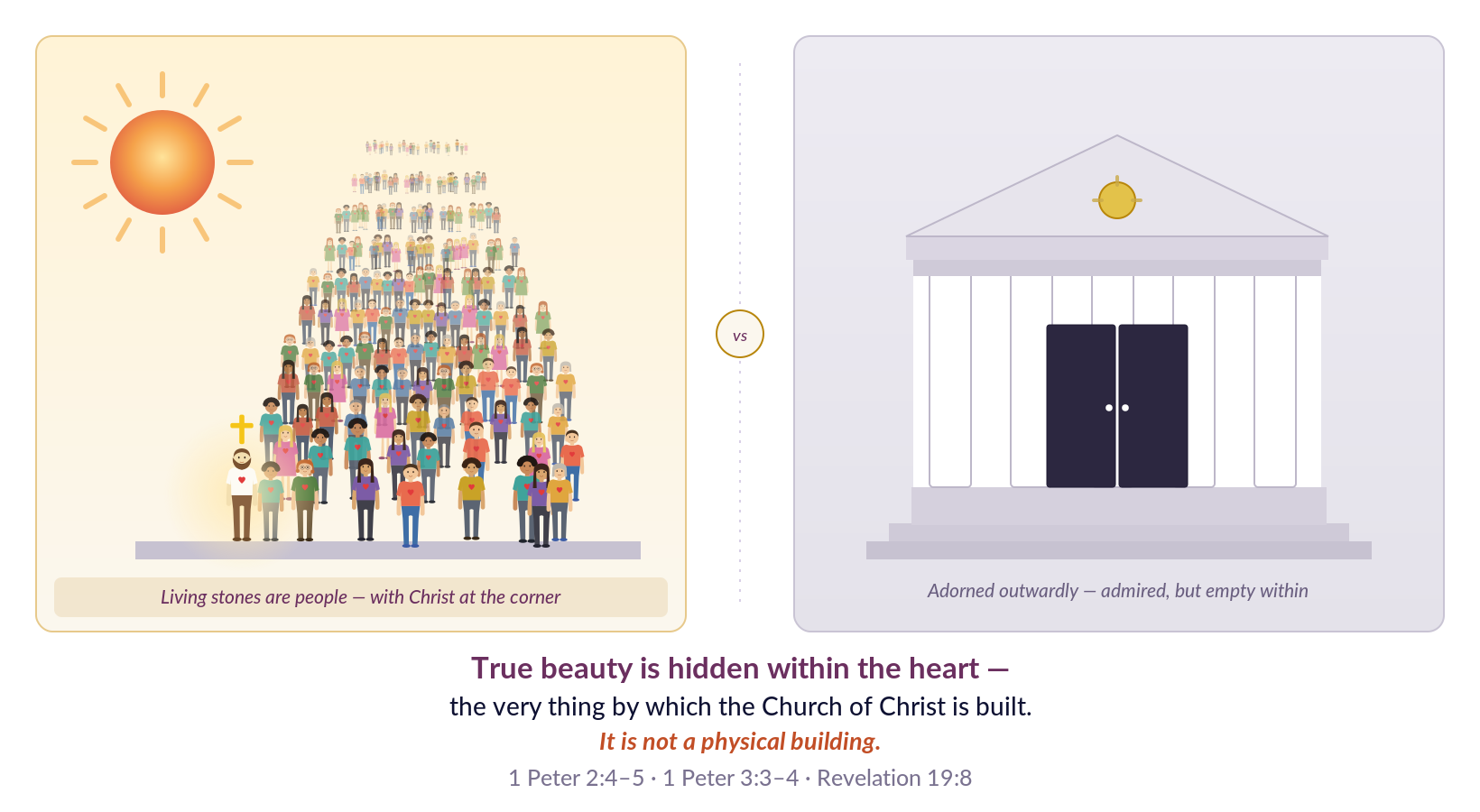
10.1 A house of living stones
Peter begins not with a building but with a Person. Christ is the living Stone — rejected by men, but chosen and precious to God; and everyone who comes to Him becomes a stone of the same kind, alive because He is alive.
“You also, as living stones, are built up as a spiritual house, to be a holy priesthood, to offer up spiritual sacrifices, acceptable to God through Jesus Christ.” (1 Peter 2:5)
The same picture runs through the New Testament. Paul tells the Ephesians they are being “built together” on the foundation of the apostles and prophets, with Christ Jesus Himself as the chief cornerstone, into a holy temple, a dwelling place for God by the Spirit (Ephesians 2:19–22). To the Corinthians he is plainer still: “You are God’s building… you are God’s temple, and the Spirit of God dwells in you” (1 Corinthians 3:9, 16). The materials are people; the Architect is God; the cornerstone is Christ (Psalm 118:22; Isaiah 28:16).
10.2 The hidden person of the heart
A chapter later, Peter turns to wives, and to the nature of true beauty. His words are addressed to the home, but they describe a principle that reaches far wider than marriage.
“Let your adorning be… not the outward adorning of braided hair and of wearing gold… but the hidden person of the heart, with the imperishable beauty of a gentle and quiet spirit, which in God’s sight is very precious.” (1 Peter 3:3–4)
Notice what Peter does and does not say. He does not despise beauty; he relocates it. Real beauty is hidden — the person of the heart. It is imperishable. It does not fade the way gold tarnishes and fashion dates. And it is measured by one gaze only: it is precious in God’s sight. Paul says the same to Timothy — that women should adorn themselves “with good works” rather than with gold and costly attire (1 Timothy 2:9–10). The adornment God prizes is character, not covering. It is the test Samuel was taught at the anointing of David: “Man looks on the outward appearance, but the LORD looks on the heart” (1 Samuel 16:7).
10.3 The wife is the picture of the Church
Why set “living stones” beside “a gentle and quiet spirit”? Because Scripture itself joins them. Marriage is not merely a convenient illustration — Paul says the one-flesh union is a “profound mystery” that refers to Christ and the Church (Ephesians 5:32). The wife’s relationship to her husband is drawn as the picture of the Church’s relationship to her Lord.
“Christ loved the church and gave Himself up for her… so that He might present the church to Himself in splendour, without spot or wrinkle… holy and without blemish.” (Ephesians 5:25–27)
So the Church is a Bride (2 Corinthians 11:2). And when John is shown her ready for her wedding, her beauty is described with striking care: “It was granted her to clothe herself with fine linen, bright and pure — for the fine linen is the righteous deeds of the saints” (Revelation 19:8). The Bride’s wedding dress is not woven of gold thread or carved from marble. It is woven of righteous deeds — the hidden, faithful, ordinary obedience of God’s people. Her adornment is exactly the adornment of 1 Peter 3: inward, imperishable, precious to God. And her posture is the wife’s posture — subject to Christ her Head “in everything,” out of reverence for Him (Ephesians 5:24). A gentle and quiet spirit, submissive to Christ, is not weakness; it is the beauty of the Bride.
This parallel runs deeper still — into what it means for husband and wife, and for the peace between them. The full treatment is in the Household volume: The Peace Plan for the Battle of the Sexes (Document 5, Part Two).
10.4 The counterfeit — a building adorned only outwardly
Set against this is the temptation Jesus named most sharply — beauty on the outside covering death within.
“You are like whitewashed tombs, which outwardly appear beautiful, but within are full of… all uncleanness. So you also outwardly appear righteous to others, but within you are full of hypocrisy.” (Matthew 23:27–28)
His disciples admired the temple’s magnificent stones. His reply refused the whole way of seeing: “There will not be left here one stone upon another that will not be thrown down” (Mark 13:1–2). The building that looked like permanence and success was the very thing that would fall. God had already said as much through Isaiah and Stephen: the Most High does not dwell in houses made by hands; the one He esteems is “he who is humble and contrite in spirit” (Isaiah 66:1–2; Acts 7:48–50).
A church can be adorned outwardly — impressive premises, polished production, crowds, reputation — and be a whitewashed tomb: looking like a bride on the outside while lacking the hidden person of the heart. Paul’s contrast holds — the outer self is wasting away, but the inner self is being renewed day by day, for “the things that are seen are transient, but the things that are unseen are eternal” (2 Corinthians 4:16–18). Outward adornment is admired by people; inward beauty is precious to God. Only one of them builds the house that lasts.
10.5 Why this shapes the Framework
This is not only a devotional point; it is the conviction the whole Framework and Platform are built on. We are not raising a building to be admired from the street. We are helping to build living stones into a spiritual house, so our attention goes to the hidden things Scripture calls beautiful:
- Gifts and calling, discerned and confirmed — the real material of the house, person by person.
- Function over frontage — the health of a church shown by how the body actually serves one another, not by its outward scale.
- The lowly counted in — the Saint who cannot use a computer, the family in hardship, the quietest member — because the Bride’s beauty is measured by God’s gaze, not the world’s.
- Righteous deeds as the true adornment — the fine linen of Revelation 19 — gathered, encouraged, and given room to grow.
The gentle and quiet spirit, the Church submissive to Christ as a wife to her husband, is not a decoration added once the building is up. It is the beauty by which the house is built at all. “Unless the LORD builds the house, those who build it labour in vain” (Psalm 127:1). Our task is simply to help His Bride make herself ready (Revelation 19:7).
In brief.
- God’s vision runs from Eden to the Kingdom, and the Church exists to serve it — not the reverse.
- Every believer carries the same Commission and a personal Mission: gifted, called, and prepared for particular works.
- The gospel is the Church’s message to those outside, and the reason the structure exists at all.
- Governance is flat under Christ as Head: a team of elders, deacons serving, the Five-Fold equipping, no senior anyone.
- The Western Church’s drift is named honestly, because a pattern cannot be recovered until the departure from it is admitted.
Where this leads. The Framework is laid; The Christian Household turns to the ground it is built on — the homes the Saints of every body come from.
Church, revive and rise. To God alone be the glory.