Part Two has walked the whole marriage: headship and what it is not, the submission and the voice of the wife, decisions, conflict, and repair. This closing chapter steps back and shows why none of it is a contest. The world speaks of a battle of the sexes — an ancient argument over who submits and who rules. Scripture tells a different story, and it tells it through a wedding.
2.10 One mystery, two marriages
Paul, writing of husband and wife, says the one-flesh union was never finally about the couple at all:
“For this reason a man will leave his father and mother and be united to his wife, and the two will become one flesh. This is a profound mystery — but I am talking about Christ and the Church.” (Ephesians 5:31–32)
Marriage is the earthly picture of a heavenly union: Christ the Bridegroom, the Church His Bride. That means everything Scripture says to wives and husbands opens twice — once into the home, and once into the life of the whole Church. Peter’s first letter works exactly this way. Before he says a word to wives, he has already described the whole Church in bridal terms: living stones being built into a spiritual house (1 Peter 2:4–5), a people who win the watching world by the beauty of their conduct (2:12), following a Lord who entrusted Himself without threat to the One who judges justly (2:21–25). When chapter 3 opens with “Wives, in the same way…”, the posture he describes is one the letter has already asked of every believer.
2.11 The wife’s posture is the Bride’s posture
Read Peter’s portrait of the wife through the mystery, and the Bride appears at every line. The wife submits to her own husband (1 Peter 3:1); the Church is subject to Christ alone as her Head, and to no other lord (Ephesians 5:24). The wife wins “without words… when they see the purity and reverence of your lives” (3:1–2); the Church wins the world by her conduct (2:12). The wife’s beauty is “the hidden person of the heart” (3:3–4); the Church’s glory is the life within her walls, never the walls themselves — living stones, not the building. The wife hopes in God and gives way to no fear (3:5–6); the Church is reverent, yet unafraid of any earthly power.
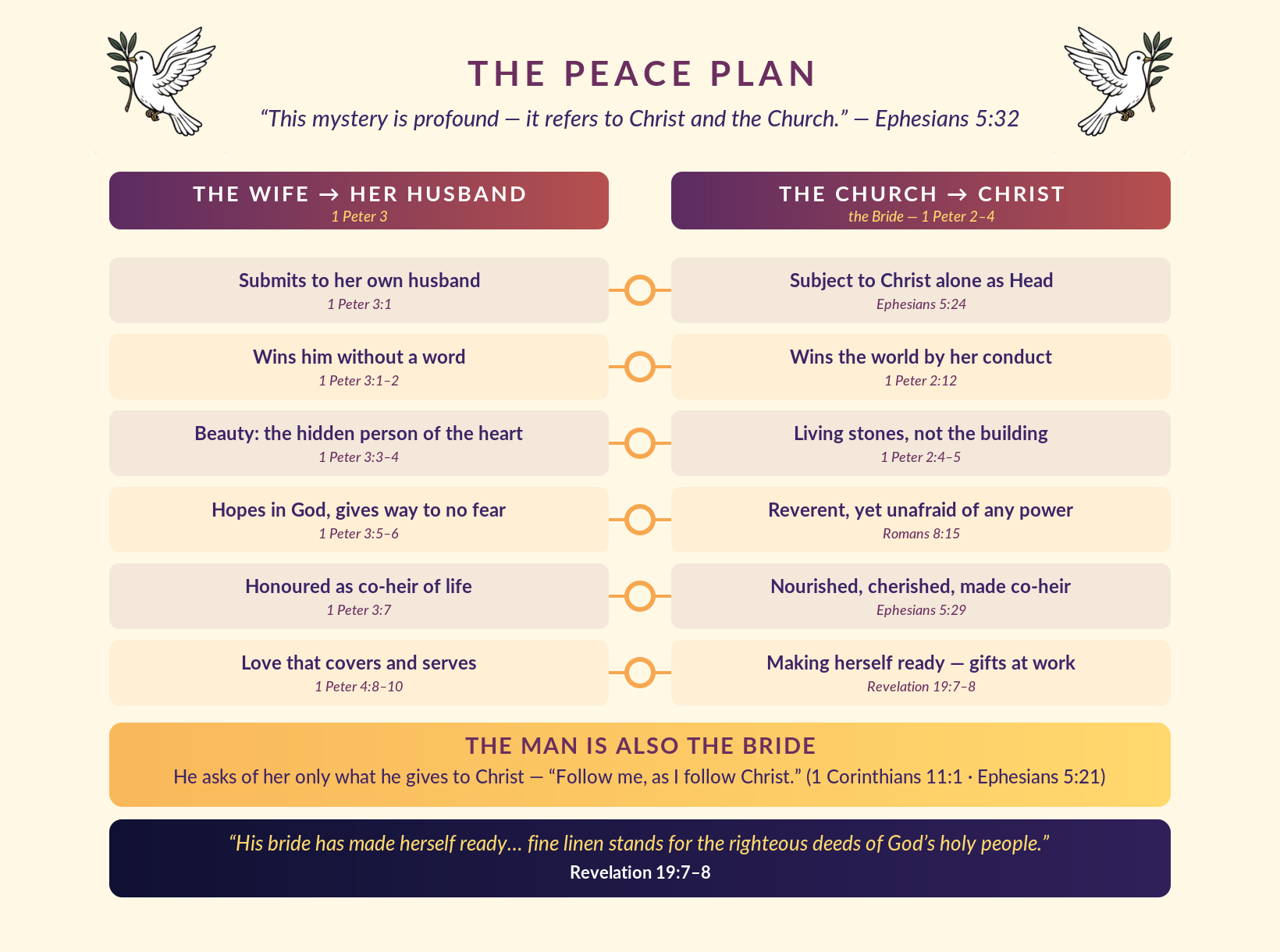
And when John finally sees the Bride dressed for her wedding, her gown confirms the parallel: “Fine linen, bright and clean, was given her to wear — fine linen stands for the righteous deeds of God’s holy people” (Revelation 19:7–8). Not gold thread. Not marble. The hidden, faithful, ordinary obedience of the Saints — the adornment of 1 Peter 3, worn by the whole Church.
2.12 The Bridegroom’s side
The analogy does not run one way. Peter turns to the husband, and what he asks of him is the Bridegroom’s own character:
“Husbands, in the same way be considerate as you live with your wives, and treat them with respect as the weaker partner and as heirs with you of the gracious gift of life, so that nothing will hinder your prayers.” (1 Peter 3:7)
Christ does not merely rule His Church; He nourishes and cherishes her (Ephesians 5:29), gave Himself up for her, and makes her co-heir of everything that is His (Romans 8:17). In this house, submission is met, always, by a love that spends itself first. A husband who demands the wife’s posture while withholding the Bridegroom’s has stepped outside the picture entirely; Peter warns that God stops listening to that man’s prayers.
2.13 The man is also the Bride
Here is the key that unlocks the whole passage. Who makes up the Bride? Men and women alike. Every man in the Church already holds toward Christ exactly the posture Peter describes in the wife: submission to his own Lord, winning others by conduct, beauty hidden in the heart, hope without fear. The wife’s posture is not a special assignment for women. It is the Bride’s posture, and every Christian man is the Bride.
So when a husband asks his wife for that posture, he is asking nothing he does not himself owe, and give, toward Christ. He is not issuing a demand from above; he is extending an invitation from alongside: follow me as I follow Christ (1 Corinthians 11:1). Submit to me as I submit to Christ. The moment a man’s leadership can no longer say that sentence honestly, it has ceased to be the leadership Scripture describes.
2.14 The peace plan
This dissolves the battle of the sexes at its root. There is no contest, because there is no difference in heart posture — husband and wife display the same submission, to the same Lord, in the same house. The husband’s headship is simply his turn to go first in it: first to sacrifice, first to serve, first to submit to Christ. Paul says it plainly, in the verse he writes before a word is addressed to wives — the verse this Part opened with:
“Submit to one another out of reverence for Christ.” (Ephesians 5:21)
Submission in this house is not a burden laid on one; it is the family likeness of everyone in it. And it is the same principle that shapes the whole Framework. The elder leads not by “lording it over those entrusted to you, but being examples to the flock” (1 Peter 5:3). The team of elders has no senior among them. The pastor’s only claim is the same as the husband’s: follow me as I follow Christ. From the household to the eldership, one pattern holds — all equal under Christ, each going first only in service, no one asking of another a posture they are not themselves giving to the Lord.
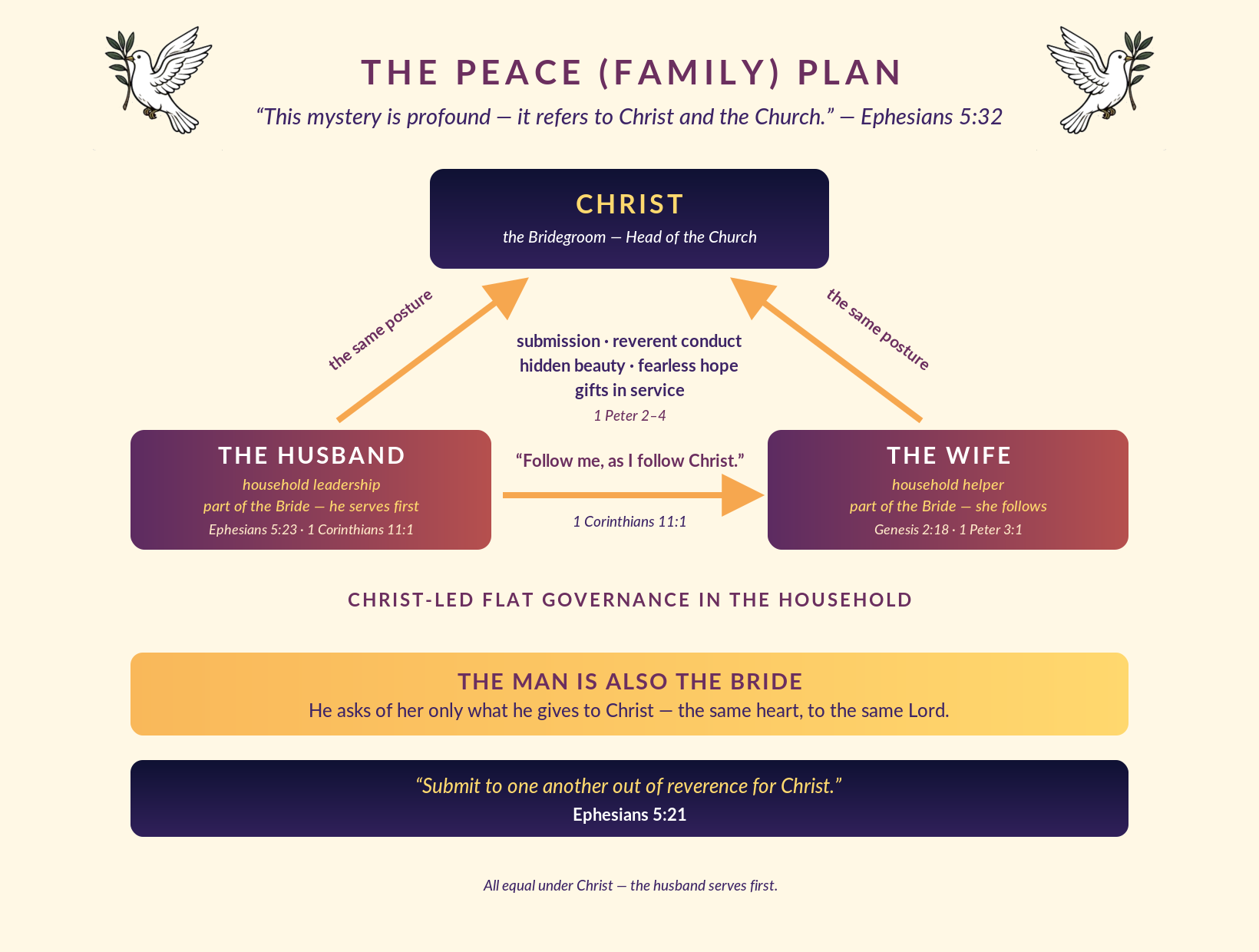
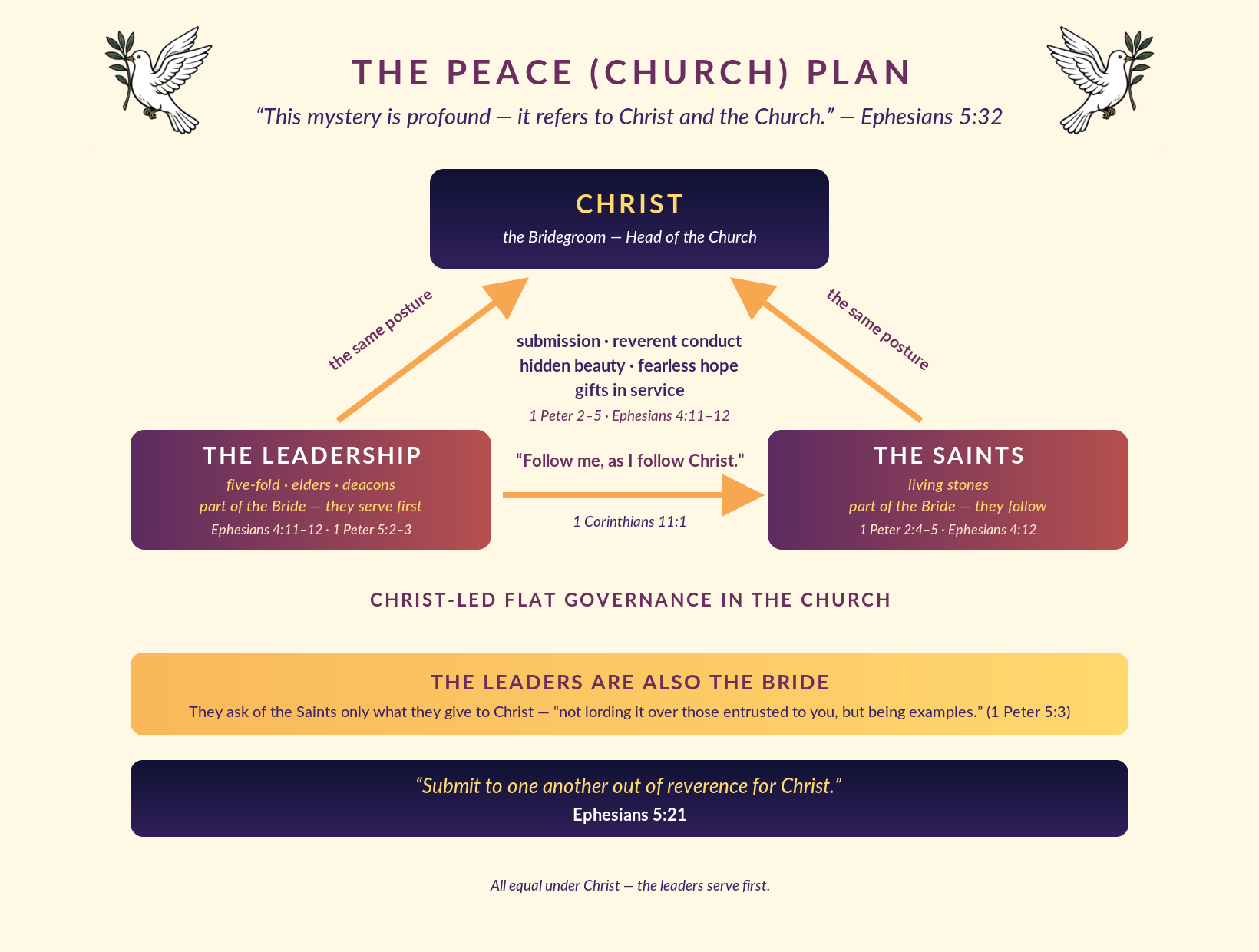
This is Christ-led Flat Governance, seen in its two spheres. In the household, the husband serves first in the very posture his wife already holds. In the church, the Five-Fold ministry and the leadership, the elders and deacons, serve first in the very posture the Saints already hold: “not lording it over those entrusted to you, but being examples to the flock” (1 Peter 5:3). Neither leads from above; both lead from alongside, under the one Head. It is one pattern in two rooms of the same house — in the church, and in the household.
2.15 The pattern behind the pattern
Two diagrams have now been drawn — one for the household, one for the church. But neither picture is the original. Both are copies of something older than the church, older than marriage, older than the world they order. The structure we see in the marriage, and again in the church, is the structure we first see in redemption itself: Jesus Christ, the highest authority in heaven and on earth, choosing a place below the angels, below His own disciples, and giving up His life for the very people He created in His image. The humility of service does not begin with husbands, and it does not begin with elders. It begins with Christ Himself, as the example.
Paul traces the whole descent in one passage:
“Though he was in the form of God, he did not count equality with God a thing to be grasped, but emptied himself, by taking the form of a servant, being born in the likeness of men. And being found in human form, he humbled himself by becoming obedient to the point of death — even death on a cross.” (Philippians 2:6–8)
The progression is striking: God, then human, then servant, then obedience, then death, and every step of the ladder goes down. Scripture measures the same descent from every side. He went below the angels: “we see him who for a little while was made lower than the angels, namely Jesus” (Hebrews 2:9). He went from riches to poverty: “though he was rich, yet for your sake he became poor” (2 Corinthians 8:9). He entered our flesh and blood entirely, “made like his brothers in every respect” (Hebrews 2:14, 17). And He tells us Himself what His heart is like at the centre: “Take my yoke upon you, and learn from me, for I am gentle and lowly in heart” (Matthew 11:29).
Then the descent is acted out in a single room, on a single evening, in front of the men who would lead His Church. John is careful to tell us what Jesus knew before He knelt. This is not a servant discovering his station; it is the Sovereign choosing it:
“Jesus, knowing that the Father had given all things into his hands, and that he had come from God and was going back to God, rose from supper. He laid aside his outer garments, and taking a towel, tied it round his waist. Then he poured water into a basin and began to wash the disciples’ feet and to wipe them with the towel that was wrapped round him.” (John 13:3–5)
All things in His hands, and the next thing those hands do is wash feet. Foot washing was the lowest servant’s task in the house; it belonged to the person with no status at all. The One with the highest authority takes the position furthest below, under the men He made, drying their feet with the towel He is wearing. And when He returns to His place, He tells them exactly what it was: “If I then, your Lord and Teacher, have washed your feet, you also ought to wash one another’s feet. For I have given you an example, that you also should do just as I have done to you” (John 13:14–15).
Here is the whole Framework in a basin of water. The example is not delegated from a distance; it is demonstrated first, at floor level, and only then required. No elder stands higher over the flock than Christ stood over the twelve, and He knelt. No husband holds more headship in his house than Christ holds over creation, and He washed. And in the verses where Jesus names the alternative He refuses — the rulers of the Gentiles “lord it over” them, “but it shall not be so among you” (Mark 10:42–43) — He gives Peter the very phrase Peter later hands to the elders (1 Peter 5:3). The church’s leadership ethic is not a management theory; it is a direct quotation of the Redeemer’s own.
“For even the Son of Man came not to be served but to serve, and to give his life as a ransom for many.” (Mark 10:45)
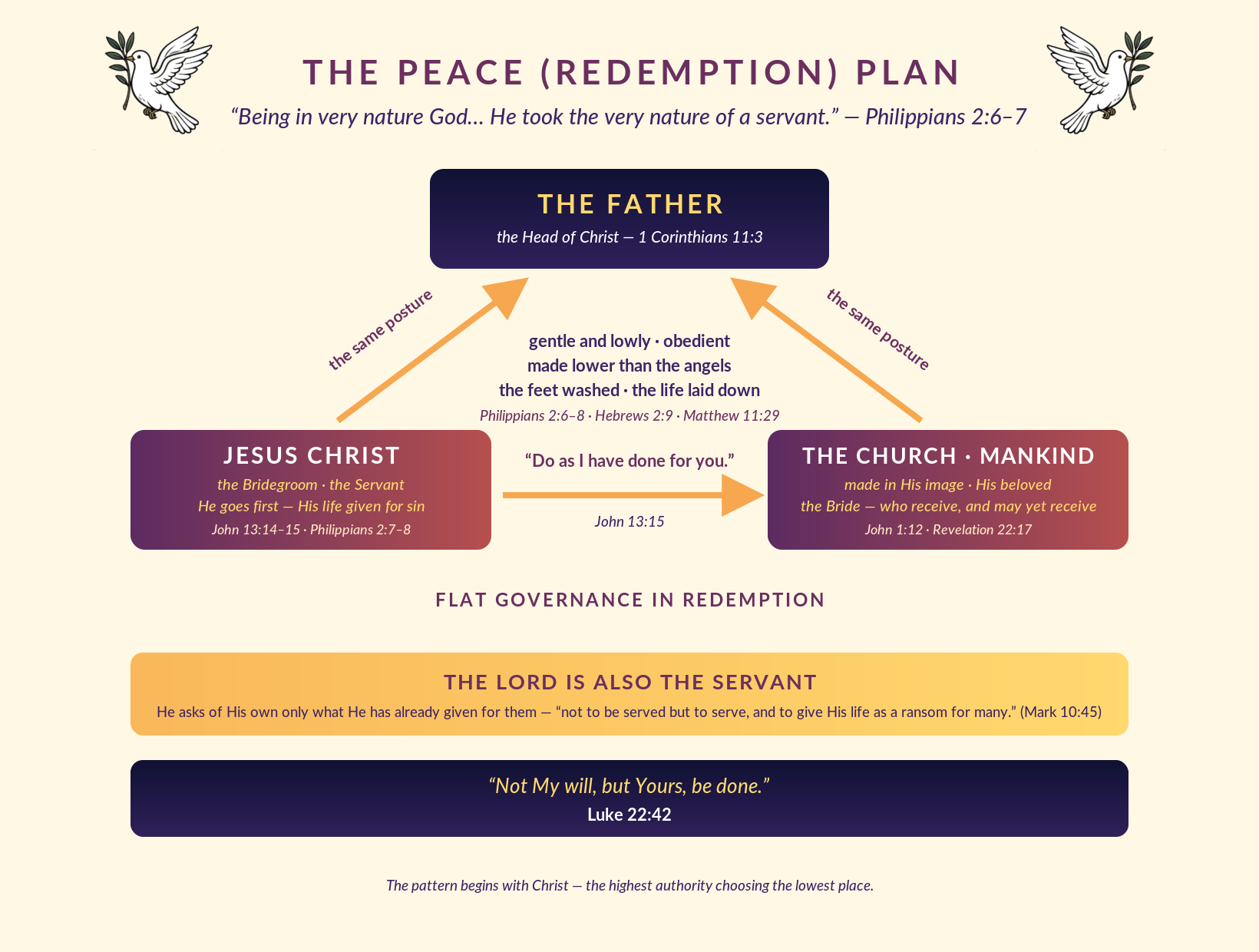
Even here there is a Head above the two boxes: “the head of Christ is God” (1 Corinthians 11:3). The Son’s descent was obedience to the Father, embraced in the garden — “not my will, but yours be done” (Luke 22:42) — and when the serving was finished He reported it upward: “I have brought you glory on earth by finishing the work you gave me to do” (John 17:4). The Son reports the finished service upward to His Head, and hands the posture downward to His people. Both arrows meet in that upper room. In the right-hand box stands the Church — all who have received Him — and, in this present age of grace, all of mankind who may yet receive Him, since “to all who did receive him… he gave the right to become children of God” (John 1:12) and the Spirit and the Bride are still saying “Come!” (Revelation 22:17).
Set the three diagrams side by side and one structure repeats. In redemption, Christ goes first — under the Father, for mankind. In the church, the leadership goes first — under Christ, for the Saints. In the household, the husband goes first — under Christ, for his wife. This is why the Framework calls its governance Christ-led and flat: not because authority does not exist, but because the seat above it is occupied by Christ, and in this Kingdom authority spends itself downward. And Paul says plainly that the descent is not merely to be admired but imitated: “Have this mind among yourselves, which is yours in Christ Jesus” (Philippians 2:5).
The twelve — the first small group
There is one more thing to notice about the room. The washing did not happen in front of a crowd. It happened among twelve men who had walked with Him for three years, in a borrowed room, at a shared meal. That setting is not incidental to the lesson; it is part of the lesson.
Jesus preached to thousands, and He could have stopped there. Instead, at the very start, He chose a small group and made shared life the point of it:
“And he appointed twelve (whom he also named apostles) so that they might be with him and he might send them out to preach.” (Mark 3:14)
Read the order carefully. So that they might be with him, and then he might send them out. Being with comes first; sending follows. The crowds got the parables; “privately to his own disciples he explained everything” (Mark 4:34). And what happened in that small company over three years is exactly what the Framework asks a team of elders to do. He knew them individually and named what He saw in them — Simon became Peter the rock, James and John the sons of thunder. He corrected them by name rather than by announcement. He sent them out in pairs to try the work, and He took the report back when they returned: “The apostles returned to Jesus and told him all that they had done and taught” (Mark 6:30). Their gifts surfaced in the doing, and were confirmed by the One who watched them do it. And He did not hold them at the distance of an office: “No longer do I call you servants… but I have called you friends” (John 15:15).
That is gift discovery, calling confirmed in community, and doing life together — in the only classroom where those things can happen. A gift cannot be identified from a stage, and a calling cannot be confirmed by a stranger. Both require someone close enough to see you serve, over long enough to tell the difference between a moment and a pattern. So when the Framework asks each elder to shepherd a small group of Saints rather than an anonymous congregation, it is not choosing a management structure or borrowing a modern small-group model. It is copying the method of the Lord Himself, who advanced the Gospel to the ends of the earth by pouring three years into twelve men, and then knelt down and washed their feet.
Who those elders are, and how a church recognises them, is the work of two documents in this Series. Elder & Deacon Identification sets out the character Paul requires, how a congregation names it without politics, and the templates for walking a man through it. Five-Fold Ministry covers the gifts given to equip the Saints alongside them. Christ chose His twelve knowing exactly whom He was choosing; a church has to look, and be told what to look for.
2.16 A fresh start for marriages
The flood story ends with a small, quiet sign. A dove goes out over the waters of judgement and comes back with a freshly plucked olive leaf in her beak (Genesis 8:11) — the first evidence that the wrath has receded, that life has begun again, that the world is being handed a fresh start. Scripture never lets go of that picture, and, remarkably, it ties it to marriage.
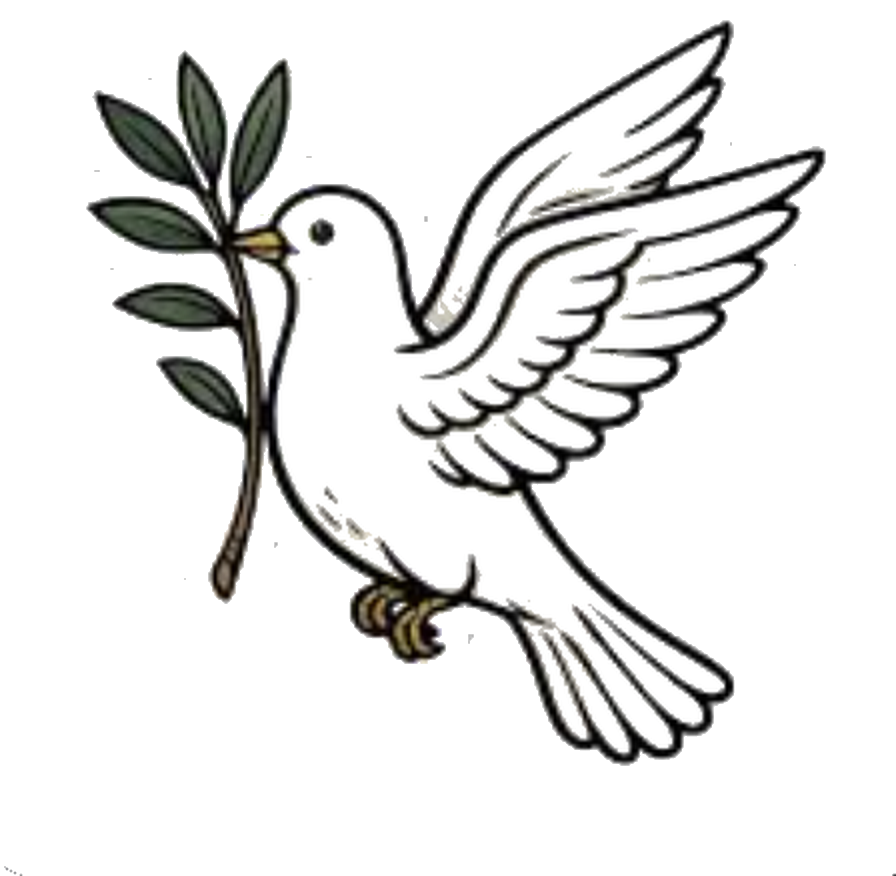
Peter ties it first. The very chapter that gives us the wife’s posture and the husband’s charge runs on to Noah: “God waited patiently in the days of Noah while the ark was being built… only a few people, eight in all, were saved through water, and this water symbolises baptism that now saves you also… by the resurrection of Jesus Christ” (1 Peter 3:20–21). The flood is not an illustration imported into the peace plan; it is native to its chapter. Every believer has already been through their own flood — the old life drowned in the waters of baptism, a washed world on the other side.
Then God Himself makes the marriage connection:
“For your Maker is your husband — the Lord Almighty is His name… To me this is like the days of Noah, when I swore that the waters of Noah would never again cover the earth. So now I have sworn not to be angry with you, never to rebuke you again… my covenant of peace shall not be removed.” (Isaiah 54:5, 9–10)
When God describes reconciliation with His estranged bride, He reaches for Noah — an oath that the anger is over, permanently. The flood as the peace plan for a marriage is not our creative reading; it is God’s own analogy.
The dove’s own journey completes the picture. The Spirit hovered over the waters at creation (Genesis 1:2); Noah’s dove crossed the waters of judgement carrying the olive leaf; and at the Jordan the dove appears once more, descending and resting on Christ as the Father declares His pleasure (Matthew 3:16–17). The dove’s journey ends on Jesus. He is where peace between God and humanity finally comes to rest — which is why the peace plan for any marriage runs through Him.
What the flood did to the old world, forgiveness does to the old hurts. God “hurls all our iniquities into the depths of the sea” (Micah 7:19) and “remembers our sins no more” (Isaiah 43:25; Jeremiah 31:34) — so husband and wife forgive “as God in Christ forgave you” (Ephesians 4:32): the past drowned, not archived for later use. What follows is new creation — “the old has gone, the new is here” (2 Corinthians 5:17) — entrusted to us as a ministry of reconciliation that counts no one’s sins against them (5:18–19). And the daily practice of it is 1 Peter 4:8: love covers a multitude of sins — the olive leaf, carried home again and again. Even the household imagery agrees: Psalm 128 blesses the home where the wife is a fruitful vine and the children are olive shoots around the table. The olive tree is what grows in a house at peace.
Where a marriage needs that fresh start and does not know how to begin it, the Framework provides a practical door. The Restoration Conversation is a free, guided path for walking out Matthew 18 repair between believers, including within a marriage, and Part Seven of this document walks the road of restoration for whole households in full. The dove goes out; the olive leaf comes back; the covenant of peace holds.