The Church exists to fulfil God’s vision on earth. Christ is the Head of the Church, and He has given the Church a clear structure and purpose: the Five-Fold ministry, elders, and deacons all exist to equip every believer for the works of ministry. The Church is not a hierarchy where a few do the ministry while the rest watch — it is the body of Christ, where every member is a minister and every leadership role exists to serve and equip the saints.
2.1 Christ — The Head of the Church
Everything begins and ends with Christ. He is the Foundation, the Head, the Cornerstone, and the One to whom the whole body is joined. Church governance starts with Jesus Christ, as Scripture makes clear:
“And God placed all things under His feet and appointed Him to be head over everything for the church, which is His body, the fullness of Him who fills everything in every way.” (Ephesians 1:22-23)
“And He is the head of the body, the church; He is the beginning and the firstborn from among the dead, so that in everything He might have the supremacy.” (Colossians 1:18)
“Instead, speaking the truth in love, we will grow to become in every respect the mature body of Him who is the head, that is, Christ. From Him the whole body, joined and held together by every supporting ligament, grows and builds itself up in love, as each part does its work.” (Ephesians 4:15-16)
“And I tell you that you are Peter, and on this rock I will build my church, and the gates of Hades will not overcome it.” (Matthew 16:18)
2.2 All Believers — A Royal Priesthood
Every believer in Jesus is a priest. The New Testament knows no clergy-laity divide. That divide — the idea that a special class of ordained professionals (the “clergy”: priests, ministers) holds the sacred work, while everyone else (the “laity”: the ordinary members) simply receives it as spectators — is nowhere taught in Scripture. Under the New Covenant there is no such two-tier arrangement: every Christian has direct access to God, is called to ministry, and is responsible to do the works of service that build up the body and advance the Kingdom.
“But you are a chosen people, a royal priesthood, a holy nation, God’s special possession, that you may declare the praises of Him who called you out of darkness into His wonderful light.” (1 Peter 2:9)
“… and has made us to be a kingdom and priests to serve His God and Father — to Him be glory and power for ever and ever! Amen.” (Revelation 1:6)
“You are worthy to take the scroll and to open its seals, because you were slain, and with your blood you purchased for God persons from every tribe and language and people and nation. You have made them to be a kingdom and priests to serve our God, and they will reign on the earth.” (Revelation 5:9-10)
2.3 The Five-Fold Ministry — Equipping the Saints
Christ has given gifted leaders to the Church not to do all the ministry themselves, but to equip every believer to do the works of ministry. This is the foundational text for understanding church leadership and purpose.
“So Christ Himself gave the apostles, the prophets, the evangelists, the pastors and teachers, to equip His people for works of service, so that the body of Christ may be built up until we all reach unity in the faith and in the knowledge of the Son of God and become mature, attaining to the whole measure of the fullness of Christ.” (Ephesians 4:11-13)
Each Five-Fold role has a distinctive function in equipping the saints:
- Apostles — establish and pioneer new works of the Kingdom
- Prophets — reveal God’s heart and direct His people
- Evangelists — proclaim the gospel and ignite faith
- Pastors (Shepherds) — nurture, guide, and care for believers
- Teachers — instruct in sound doctrine and ground believers in truth
2.4 Elders and Overseers — Local Leadership
Local churches are shepherded by elders (also called overseers; a modern, relatable equivalent would be team leader) who watch over the flock, govern wisely, protect the church, and feed God’s people with His Word.
“To the elders among you, I appeal as a fellow elder and a witness of Christ’s sufferings who also will share in the glory to be revealed: Be shepherds of God’s flock that is under your care, watching over them — not because you must, but because you are willing, as God wants you to be; not pursuing dishonest gain, but eager to serve; not lording it over those entrusted to you, but being examples to the flock.” (1 Peter 5:1-3)
“Keep watch over yourselves and all the flock of which the Holy Spirit has made you overseers. Be shepherds of the church of God, which He bought with His own blood.” (Acts 20:28)
“He must hold firmly to the trustworthy message as it has been taught, so that he can encourage others by sound doctrine and refute those who oppose it.” (Titus 1:9)
“Have confidence in your leaders and submit to their authority, because they keep watch over you as those who must give an account. Do this so that their work will be a joy, not a burden, for that would be of no benefit to you.” (Hebrews 13:17)
2.5 Deacons and Servants — Practical Service
Deacons (literally “servants”) attend to the practical needs of the church so that the ministry of the Word, prayer, and equipping can flourish unhindered.
“It would not be right for us to neglect the ministry of the Word of God in order to wait on tables. Brothers and sisters, choose seven men from among you who are known to be full of the Spirit and wisdom. We will turn this responsibility over to them and will give our attention to prayer and the ministry of the word.” (Acts 6:2-4)
“In the same way, deacons are to be worthy of respect, sincere, not indulging in much wine, and not pursuing dishonest gain. They must keep hold of the deep truths of the faith with a clear conscience. They must first be tested; and then if there is nothing against them, let them serve as deacons.” (1 Timothy 3:8-10)
“Paul and Timothy, servants of Christ Jesus, to all God’s holy people in Christ Jesus at Philippi, together with the overseers and deacons.” (Philippians 1:1)
2.6 The Equipping Model — A Visual Summary
The New Testament pattern, in brief: Christ is the Head, all believers are the royal priesthood doing the works of ministry, and the Five-Fold ministry, elders, and deacons are supporting roles that exist to equip, shepherd, and serve so that the Saints can do the work and the body can be built up. This summary is unpacked in fuller detail in Chapter 6 (Church Governance Structure — A Closer Look) and set out in full, as a single integrated picture with its complete walkthrough, in Chapter 9 (Strategy on a Page). The point here is simply to set out the structure in its essentials before moving on.
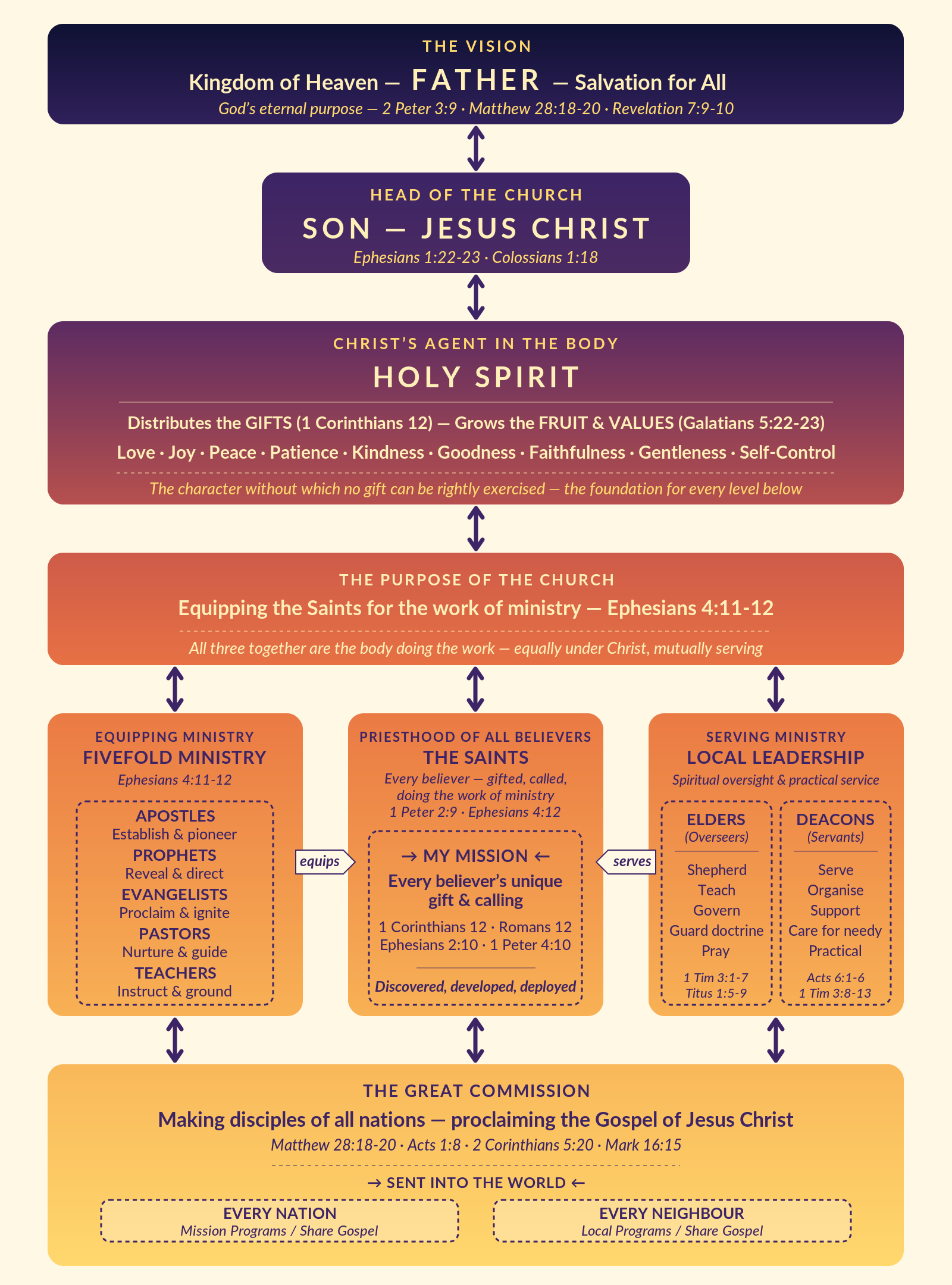
This is the structure God appointed when the priesthood was changed. In the Old Testament, God’s people approached Him through the Tabernacle and then the Temple, with a separate priestly class (the Levites) and a High Priest who alone could enter the Most Holy Place, and only once a year.
With the death and resurrection of Christ, that whole order was fulfilled and changed. Christ Himself, ascended and enthroned at the Father’s right hand, is now the eternal High Priest — not in the order of Aaron, but in the order of Melchizedek (Hebrews 7). And because the priesthood was changed, the structure of God’s people was changed with it. The Levitical class is gone; the whole Church is now the priesthood (1 Peter 2:9). Every believer has direct access to God through the once-for-all sacrifice of His Son. This pattern — Christ as Head, every believer as priest, and supporting roles that equip and serve — is the structure He Himself chose for His people in this New Covenant age.
“If perfection could have been attained through the Levitical priesthood — and indeed the law given to the people established that priesthood — why was there still need for another priest to come, one in the order of Melchizedek, not in the order of Aaron? For when the priesthood is changed, the law must be changed also.” (Hebrews 7:11-12)
“For it is declared: ‘You are a priest forever, in the order of Melchizedek.’” (Hebrews 7:17)
“From Him the whole body, joined and held together by every supporting ligament, grows and builds itself up in love, as each part does its work.” (Ephesians 4:16)