Everything to this point has set out who decides what. This Section asks the question underneath all of it: when a church sits down to decide, how is the Lord’s will actually made known? The New Testament gives three scenes, and they are remarkably consistent.
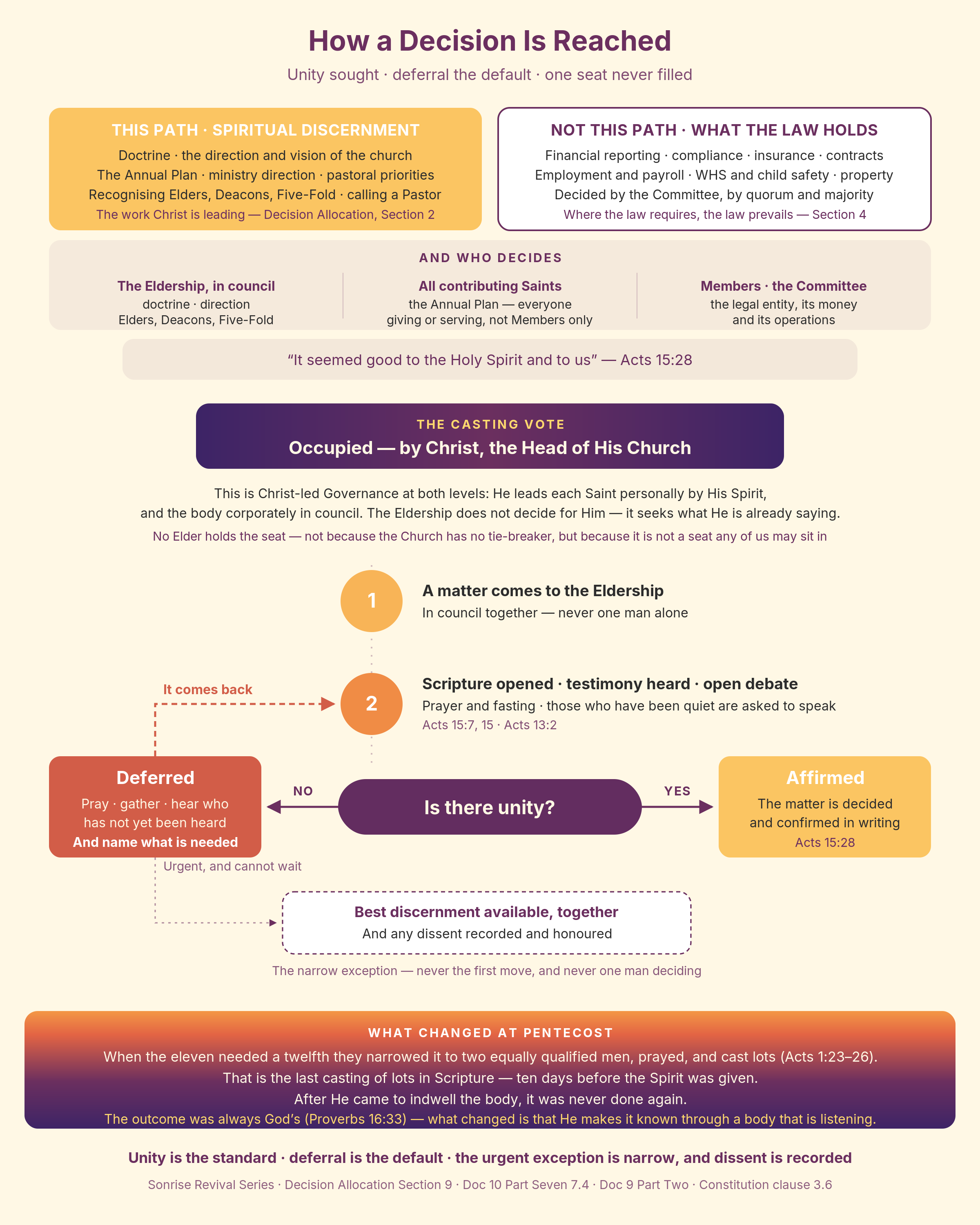
Figure — How a decision is reached. The seat no Elder holds, and what happens when unity is not there.
Acts 6 — the body chooses, and the apostles pray
The first recorded decision after Pentecost begins with a complaint, not a strategy. The Hellenistic widows “were being overlooked in the daily distribution” (Acts 6:1). The Twelve do not solve it themselves and do not appoint a committee over it. They name the limit — “it would not be right for us to neglect the ministry of the word of God in order to wait on tables” — and hand the choosing to the body: “choose seven men from among you who are known to be full of the Spirit and wisdom” (Acts 6:2–3).
Notice who does the choosing and on what basis. The body chooses, because the body is who knows these men. The qualification is character already visible. The apostles then pray and lay hands on the seven (Acts 6:6). Discernment and recognition are shared between the body that has seen the life and the leadership that carries the charge.
Acts 13 — direction given in worship, confirmed before it is acted on
The sending of Barnabas and Saul does not begin in a meeting called to decide anything. “While they were worshipping the Lord and fasting, the Holy Spirit said, ‘Set apart for me Barnabas and Saul for the work to which I have called them’” (Acts 13:2). The church at Antioch was not deliberating. It was worshipping.
And what follows is just as instructive: “after they had fasted and prayed, they placed their hands on them and sent them off” (Acts 13:3). They had heard clearly, and they still fasted and prayed again before acting. Direction that comes in worship is still brought back to the body for confirmation.
Acts 15 — open debate, Scripture consulted, and a finding the council owns
The hardest doctrinal question the early church faced was not settled by an apostle ruling on it. There was “much debate” (Acts 15:7). Peter gave testimony from his own experience. Barnabas and Paul reported what God had done. James summarised and proposed a finding, opening the Scriptures as he did it — “this is in agreement with the words of the prophets, as it is written” (Acts 15:15). The council then decided, and the letter that went out carried the most remarkable phrase in the New Testament on decision-making: “It seemed good to the Holy Spirit and to us” (Acts 15:28).
Not the Spirit told us and we transcribed it. Not we voted and hoped. A council of people, listening hard, reached a conclusion they were willing to attribute jointly to the Spirit and to themselves.
What the three scenes share
- Never one man alone. In every case the deciding is done by a body — the gathered church, the prophets and teachers at Antioch, the apostles and elders with the whole church.
- Never a bare majority. The language is agreement, not arithmetic. “It seemed good.” Nobody counts.
- Those deciding knew the matter and the people. The body chose the seven because it had watched them. Antioch knew Barnabas and Saul. Jerusalem heard first-hand testimony before it concluded anything.
- The Spirit worked through an ordinary human process, not around it. Testimony, Scripture, debate, prayer, fasting, the laying on of hands. The Spirit is not an alternative to thinking carefully together; He is who makes thinking carefully together fruitful.
What changed at Pentecost
There is one more scene, and it comes just before the Spirit is given. When the eleven needed a twelfth, they put forward two men who both met the stated criteria, prayed “Lord, you know everyone’s heart — show us which of these two you have chosen”, and cast lots. The lot fell to Matthias (Acts 1:23–26).
Two things are worth seeing in it. First, the lot never did the work of judgement: the body had already narrowed the field to two men it had assessed and found equally qualified. It resolved a genuine tie; it did not replace discernment. Second, and more significantly — that is the last recorded casting of lots in Scripture. It happens ten days before Pentecost. After the Spirit comes to indwell the church, it is never done again.
The principle behind it has not changed. “The lot is cast into the lap, but its every decision is from the LORD” (Proverbs 16:33) — the outcome always belonged to God, and still does. What changed is how He discloses it. The Spirit now lives in the body, so His will is made known through that body listening together, rather than through a method that bypasses it. Acts 15:28 is what Acts 1:26 became.
So what about two genuinely good options?
This is the practical question the three scenes leave, and the Framework’s answer is deliberately not a tie-break. Where unity is not present, the matter is deferred for further prayer rather than rushed to a decision (Section 6). Before reaching for a mechanism, an Eldership has better questions available to it: what does Scripture actually say about this; who has first-hand knowledge we have not heard from; who will carry the consequence and have they spoken; and is this genuinely a tie, or is it a decision nobody wants to be the one to make?
Most matters that feel evenly balanced are not. They feel that way because the hard half has not been said out loud yet. And where a decision is genuinely urgent and cannot wait, the Council reaches the best discernment available together, and any dissent is recorded and honoured — which is a very different thing from drawing for it.
The one seat that is never filled is the casting vote. No Elder holds it, not because the Church has no tie-breaker, but because that is not a seat any of us may sit in.