Purpose. Who decides what, and why — every typical decision a church makes, assigned to the body best placed to discern it: the Saints, the Eldership, the Five-Fold, or the Committee.
Where this sits. Volume IV. With the eldership recognised and the Five-Fold released, this is where authority is actually distributed.
Audience. Elderships and committees settling how their body decides, and any Saint who wants to know where their voice carries.
Before you read. Elder & Deacon Identification and Five-Fold Ministry — this document allocates decisions between the bodies those two describe.
How to use this document. Sections 1 to 4 take each body in turn; Section 5 handles the decisions that move through several in sequence. The three law notes at the end show how the allocation sits inside company and association law.
Across seven worked example church analyses produced in preparing this Series — real Victorian churches, read only from their public records, and not themselves published (Section 6) — we observed a striking level of inconsistency in how Australian churches allocate decision-making authority. Some churches put nearly every significant decision to a Members’ vote. Others concentrate authority almost entirely in the Senior Pastor or Senior Minister. Some have a two-tier Member/Partner structure that limits voting to a small leadership-endorsed body. Others extend Members’ votes into matters where the Framework would say vote is the wrong instrument.
This document cuts through that inconsistency. It sets out, in table form, every typical decision a Christian church needs to make to function according to its vision and mission, and groups those decisions by who should make them and why. The four decision-makers are the Saints (Members as a whole), the Eldership, the Five-Fold ministry, and the Committee (the entity Board responsible for legal stewardship).
The underlying principle is simple. Decisions belong to whoever is best placed to discern them in the Lord, not to whoever has the loudest claim to authority. Spiritual discernment goes to those gifted for spiritual discernment. Body commitment goes to the body. Legal stewardship goes to those gifted for legal stewardship. Each layer serves the others, none competes, and Christ is the only Head of the Church.
The four decision-makers, briefly
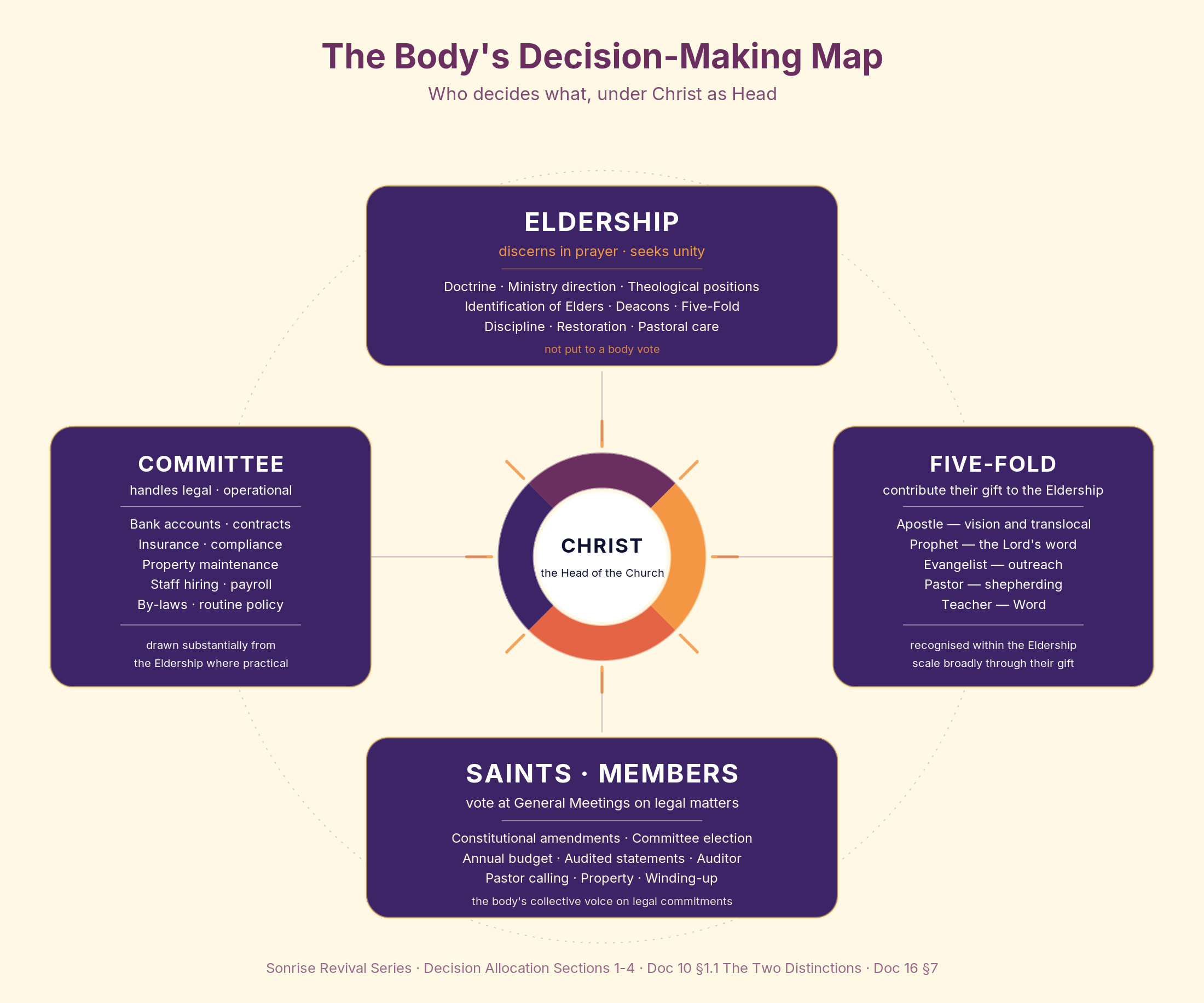
Saints — the Members of the church as a whole. The body of confessing adult believers who have applied for and been accepted into Membership. The Saints decide matters that touch the body’s commitment, identity, and legal-structural form. Decisions are made by vote at General Meetings.
Eldership — the body of recognised Elders, identified through the Framework’s Doc 10 Part Four ten-stage discernment process and walking together in spiritual oversight of the church. Decisions are made in prayer and fasting, seeking unity.
Five-Fold ministry — those operating in the offices of apostle, prophet, evangelist, pastor, and teacher under Ephesians 4:11. These offices contribute their gift to the Eldership’s discernment rather than making standalone governance decisions. In framework-aligned churches, the Five-Fold substantially overlap the Eldership.
Committee — the legal body (Board, Management Committee, or equivalent) responsible for the entity’s legal stewardship, operational management, and regulatory compliance. The Framework calls for the Committee to be drawn substantially from the Eldership where practical, so the legal authority and spiritual posture are integrated rather than separated.