10.1 — Why this Part exists
Parts One through Nine of this Document set out the framework’s view of Eldership and Diaconate identification for a single body of Saints meeting under shared spiritual oversight. The Identification Process (Part Four), the Qualifications (Part Three), and the patterns of How an Eldership Functions Together (Part Seven) all assume an Eldership where every Elder can sit around one table together, know one another, pray together, and reach unity in council. That works to about 200 to 300 active adult Saints. Beyond that, the body has grown larger than a single Eldership of seven or eight can shepherd, and the question becomes: how does the Eldership scale without losing what makes it an Eldership?
This Part answers that question, and is one of the most consequential clarifications in this Document. The wrong answers are common in the Australian church and produce the patterns Document 1 (Vision, Purpose, Commission & Mission) Chapter 8 warns about. The right answer is straightforward in principle but requires deliberate discipline to operate. The principle is: as the body grows, the Eldership grows in number but stays equal in office. No Senior Pastor designation. No Executive Eldership tier. More Elders. More pastors among them. The chair function for administrative facilitation. Council together. The Lord at the Head.
10.2 — Two wrong answers
The first wrong answer is the corporate-template pattern of designating a Senior Pastor with concentrated authority who functions as the CEO of a growing ministry. The Senior Pastor chairs the Eldership ex officio, holds casting votes, employs and dismisses staff at sole discretion, sets the AGM agenda, sits on the legal Board, and is treated as the primary face and voice of the body. Every one of the seven Australian churches analysed by the framework analyses companion to this Series carries this pattern in some form. The framework, properly articulated, rejects it. The Senior Pastor designation creates the one-man-show pattern Document 1 Chapter 8 warns against. It also breaks down at scale — the larger the body, the more concentrated the authority becomes, until the entire ministry runs through one person and the body cannot function without them.
The second wrong answer is creating an Executive Eldership tier inside the Eldership — a small group of senior Elders who make the substantive decisions while the rest of the Eldership becomes effectively a rubber stamp. This pattern is common in growing churches that resist the Senior Pastor concentration but still feel the need for a "manageable" decision-making body. The framework rejects this too. Tiered eldership creates corporate hierarchy under spiritual language. The larger body of Elders feels — and over time becomes — second-class. The small executive eldership becomes the actual decision-maker. The body suffers the same drift in slower form.
10.3 — The right answer: flat multiplication
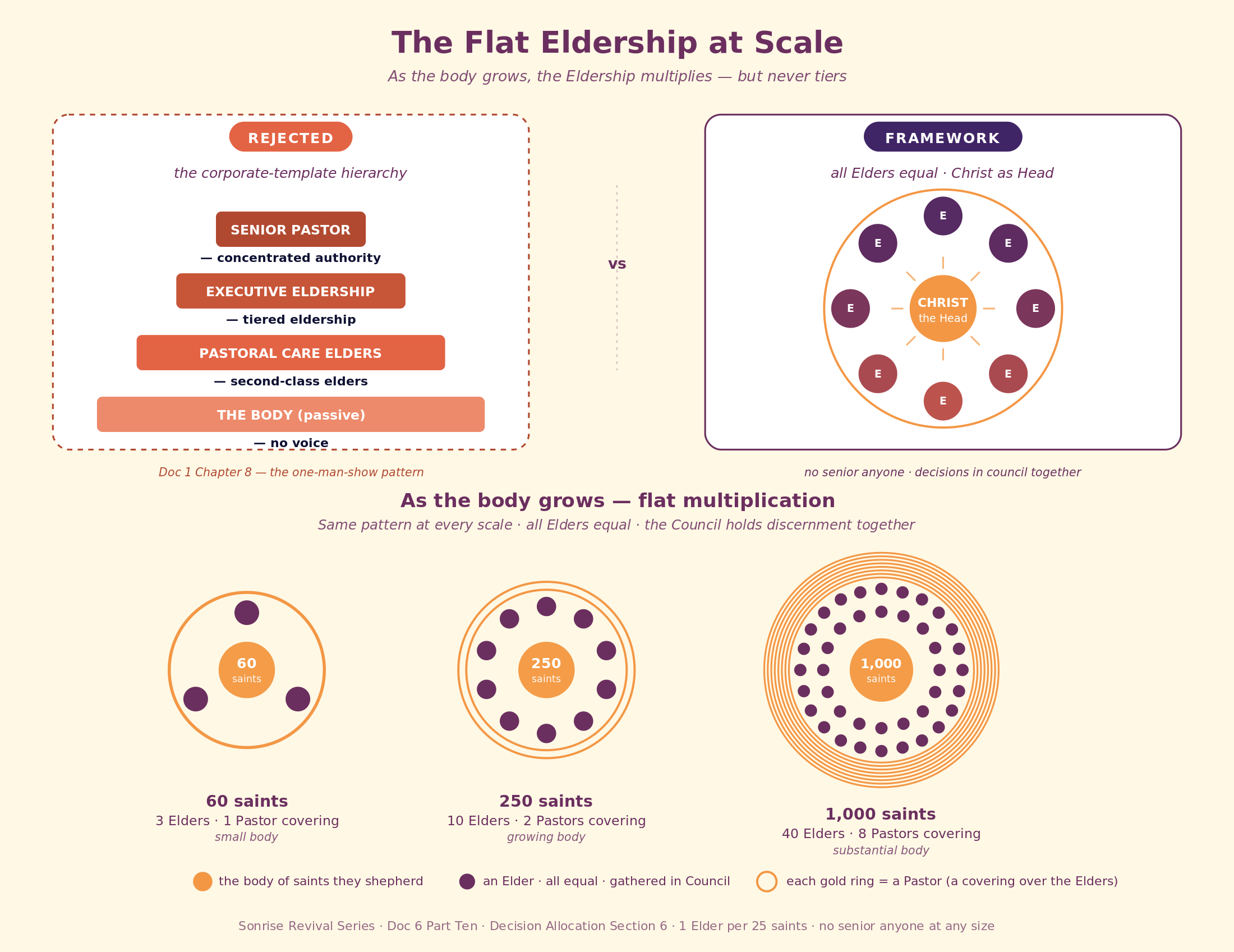
Figure — The Flat Eldership at Scale. As the body grows, the Eldership multiplies — but never tiers. One Pastor among five Elders is shown as a gold ring covering the Council.
As the body grows, the Eldership grows in number but stays equal in office. Every Elder is equal. Different gifts (pastor, teacher, prophet, evangelist, apostle) mean different functions, not different ranks. A pastor is an Elder who carries the pastoral gift in the Ephesians 4:11 sense, but holds no more authority than any other Elder. When more pastoral capacity is needed as the body grows, the Eldership recognises and installs more Elders with the pastor gift through the same Part Four ten-stage identification process used for every new Elder. The body has many pastors, all of whom are Elders, all of whom are equal.
The New Testament pattern supports this. The Jerusalem council in Acts 15 was "the apostles and elders" together. No senior apostle ran the meeting. James the brother of the Lord facilitated but did not command. The Antioch church in Acts 13 named multiple prophets and teachers — Barnabas, Simeon called Niger, Lucius of Cyrene, Manaen, and Saul — operating together without one of them being "senior" over the others. The Pauline pattern in Ephesus (Acts 20) calls "the elders of the church" together as a single body of equals. Where the New Testament names plurality of leadership, it does not name hierarchy within that plurality.
10.4 — The four ratios that matter at scale
Four ratios shape the practical scaling of an Eldership. The numbers below are working targets, not absolute requirements. Healthy churches operate within the ranges given.
Saints to Elder — target 1:25, healthy range 1:20 to 1:30. An Elder shepherding 25 Saints can know them personally, know their household, pray for them by name, notice when they are absent, see signs of struggle, walk with them through significant life events. At 1:35 and above, knowing starts to fragment into managing.
Saints to Pastor in the Ephesians 4:11 sense — target 1:125, healthy range 1:100 to 1:150. A pastor carries the teaching-with-pastoral-heart function and the pastoral leadership voice. At 125 Saints per pastor, the body has enough teaching depth and pastoral leadership without any single pastor being indispensable.
Elders to Pastor — target 1 in 5 Elders, healthy range 1 in 4 to 1 in 6. Not every Elder carries the Ephesians 4:11 pastor gift. Many are teachers, prophets, evangelists, or carry administrative gifting. Roughly 1 in 5 Elders typically carries the pastor gift specifically.
Saints to Deacons — target 1:10, healthy range 1:8 to 1:15. The Diaconate is the practical-service office under 1 Timothy 3:8 to 13. Deacons handle the practical needs that flow out of pastoral care. The Exodus 18:21 ratio of captains of tens is the biblical reference.
And one ratio that does not scale with body size — the Operational Committee. A Committee of 5 to 9 members regardless of body size manages the legal stewardship. A Committee of 7 can handle operations for 100 Saints or 10,000 Saints — the difference is met by professional support (paid administrators, bookkeepers, ministry coordinators), not by adding committee members.
10.5 — What scaling looks like at sample body sizes
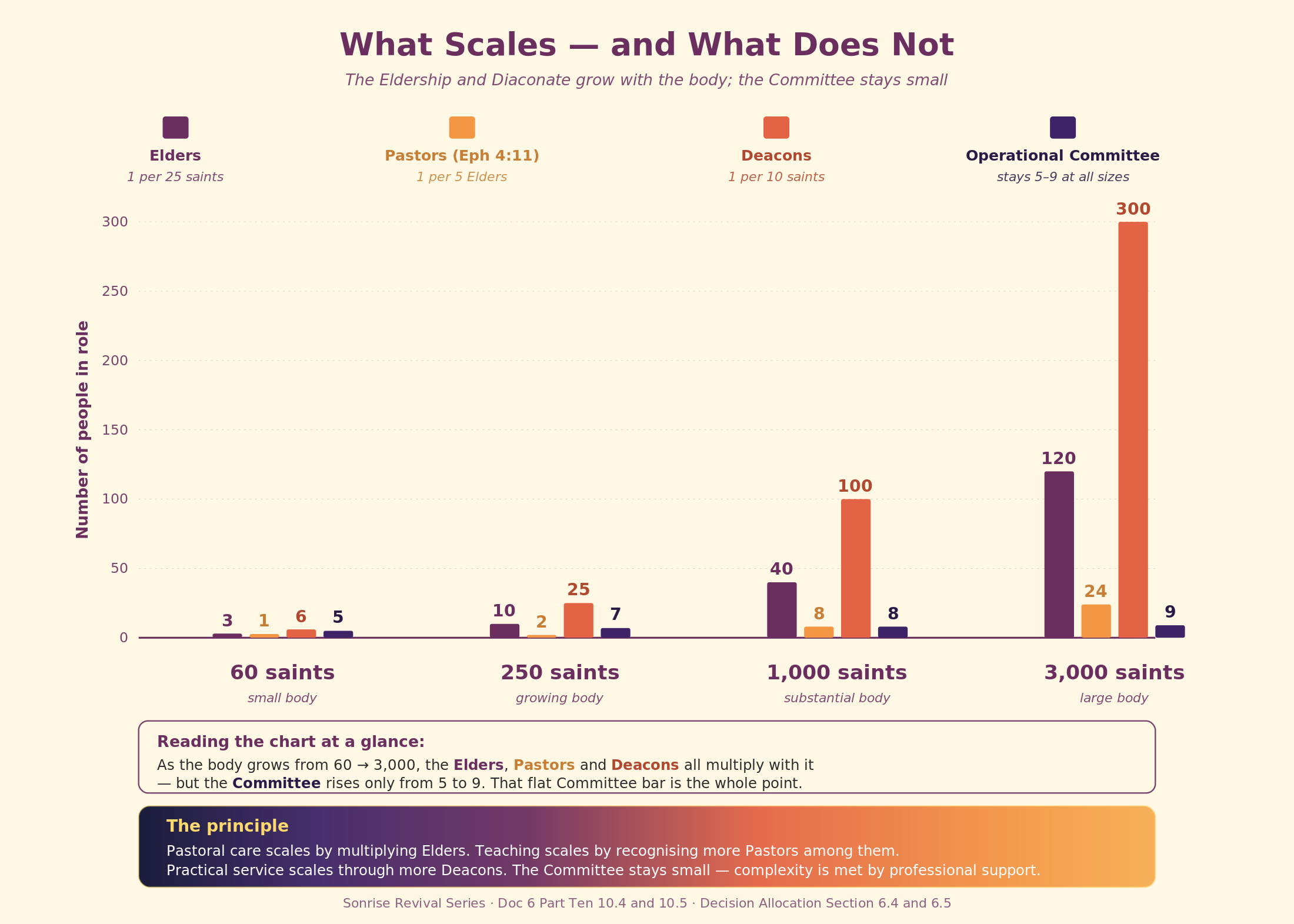
Figure — What Scales — and What Does Not. The Eldership and Diaconate grow with the body; the Committee stays small.
Applying the four ratios at sample body sizes shows the practical shape of a framework-aligned Eldership at scale.
At 60 Saints — approximately 3 Elders, 1 of whom carries the pastor gift, 6 Deacons. Operational Committee of 5 members drawn from the Eldership.
At 250 Saints — approximately 10 Elders, 2 of whom carry the pastor gift, 25 Deacons. Operational Committee of 7 members.
At 1,000 Saints — approximately 40 Elders, 8 of whom carry the pastor gift, 100 Deacons. Operational Committee of 7 to 9 members plus a small paid operations team.
At 3,000 Saints — approximately 120 Elders, 24 of whom carry the pastor gift, 300 Deacons. Operational Committee of 9 members plus a professional operations team.
Notice what scales and what does not. The Eldership and Diaconate scale roughly linearly with body size. The number of pastors scales linearly but at one-fifth the Elder rate. The Operational Committee stays small regardless. This pattern protects the body from the corporate-template drift while keeping legitimate operational capacity in place.
10.6 — How a large flat Eldership reaches spiritual discernment
Before describing the disciplines, a clarification of scope. This Section addresses the spiritual oversight decisions assigned to the Eldership — doctrine, identification of new Elders and Deacons and Five-Fold ministers, ministry direction, theological positions, restoration of fallen Saints, pastoral care priorities, and the ongoing spiritual leadership of the body. These are matters of discernment in prayer, not legal-entity decisions. Legal and structural decisions — Committee election, Constitutional amendment, annual budget approval, property transactions, the calling of pastoral staff — remain with the Members at General Meetings regardless of how large the Eldership becomes. Operational matters — banking, contracts, compliance, employment of administrative staff — remain with the Committee. The disciplines below are for the Eldership’s spiritual discernment work specifically.
The most common practical objection to flat multiplication is that "a body of 40 Elders cannot discern together in council." The objection is wrong, but it is wrong only where the right discipline is brought to bear. A body of 40 trying to discern by show-of-hands or by motion-debate-vote would be chaos. A body of 40 walking corporate spiritual discernment with appropriate discipline is achievable, and faithful traditions have practised it across the centuries.
The disciplines that make large-Council spiritual discernment work:
- Agendas are prepared in advance and sent out with background reading at least a week before each Council meeting. Elders come ready, having prayed and read.
- Working groups (small, time-bound, no decision-making authority) prepare research, draft proposals, and surface relevant scripture. They serve the Council; they do not replace it.
- Discussion is structured with listening rounds before any push toward conclusion. Every Elder who wishes to speak is heard before any direction is sought. Discernment is collective listening, not competitive argument.
- Unity is sought as the standard, not majority. Where unity is not present, the matter is deferred for further prayer rather than rushed to a decision. Where the matter is urgent and a decision must be made, the Council reaches the best discernment available together and any dissent is recorded and honoured.
- The chair function rotates or is designated for administrative facilitation only — agenda flow, time-keeping, recording. The chair does not vote with extra weight, does not break ties, does not steer outcomes. The chair serves the Council’s discernment; the chair does not lead it.
- Council meetings happen substantively often enough — typically monthly or bi-monthly — that genuine discernment can occur and decisions are not perpetually deferred. Urgent matters can be addressed in special Council sessions called between regular meetings.
- Prayer frames the work. Each Council meeting begins and ends in prayer, with prayer woven through the discernment of any matter of weight. The Eldership is not a board meeting; it is a body of shepherds seeking the Lord together for the flock He has entrusted to them.
The discipline of large-Council spiritual discernment is part of what makes the body of Christ visibly different from corporate decision-making. The work is harder than running a board meeting. The fruit is the body’s ongoing alignment with what the Lord is doing rather than with what efficient process would produce.
10.7 — Closing the loop with Documents 8, 11, and 12
This Part is articulated more briefly in Document 8 (Five-Fold Ministry) Part Ten (Five-Fold Gifts at Scale Across the Flat Eldership), with the focus there on how the non-pastoral Five-Fold gifts scale broadly without needing one-per-25 multiplication. It is articulated in Document 11 (Example Constitution) as part of the Example Constitution structural provisions, where the legal language preserves the flat-eldership-with-pastors model. It is articulated in Document 12 (Our Church — white label) in plain language so that the body itself understands why there is no Senior Pastor designation and why there is no Executive Eldership tier. And it is given its own dedicated Section in the Church Decision Allocation document with the full ratios tables, the sample scaling, and the discipline of large-Council discernment laid out in detail. Wherever the framework is read, this Part’s teaching reads consistently.
The flat multiplication model is what allows a framework-aligned church to grow into thousands without becoming a corporation. Senior Pastor designation, Executive Eldership tiers, and other forms of concentrated authority feel necessary at scale only because the alternative — disciplined discernment in a flat Council — has not been practised. The discipline can be learned. The pattern can be operated. The body of Christ can grow large without abandoning the shape Christ Himself laid down for her.