Chapters 1 through 8 have set out the full framework, based on the biblical pattern in language and detail. This chapter draws the whole picture together in a single integrated diagram and a brief supporting explanation. The diagram uses the exact vocabulary established in the previous chapters — Vision, Purpose, Commission, Mission, and Values — and shows how each element relates to the others as one coherent whole.
The intent is informational and educational. The diagram does not prescribe a particular legal structure, denominational arrangement, or constitutional form. Legal and corporate structures vary by country and by tradition, and many are inflexible by law. What follows is the biblical pattern that should inform the church’s practice, vision, and ordering of relationships within whatever legal shell exists.
Two audiences are particularly in view. First, new church plants — where the leadership has the opportunity to design from the ground up around the biblical pattern. Second, existing churches considering a renewed alignment to the biblical pattern after the kind of honest self-examination described in Chapter 7. If the examination has revealed drift, the leadership may rightly conclude that realignment is needed. This diagram offers the picture they can hold in mind as they pursue it.
The page that follows is designed to be printable on its own — a single sheet that an elder, pastor, planter, or member can keep in front of them as they read, plan, pray, and lead. The explanation after the diagram walks through each element.
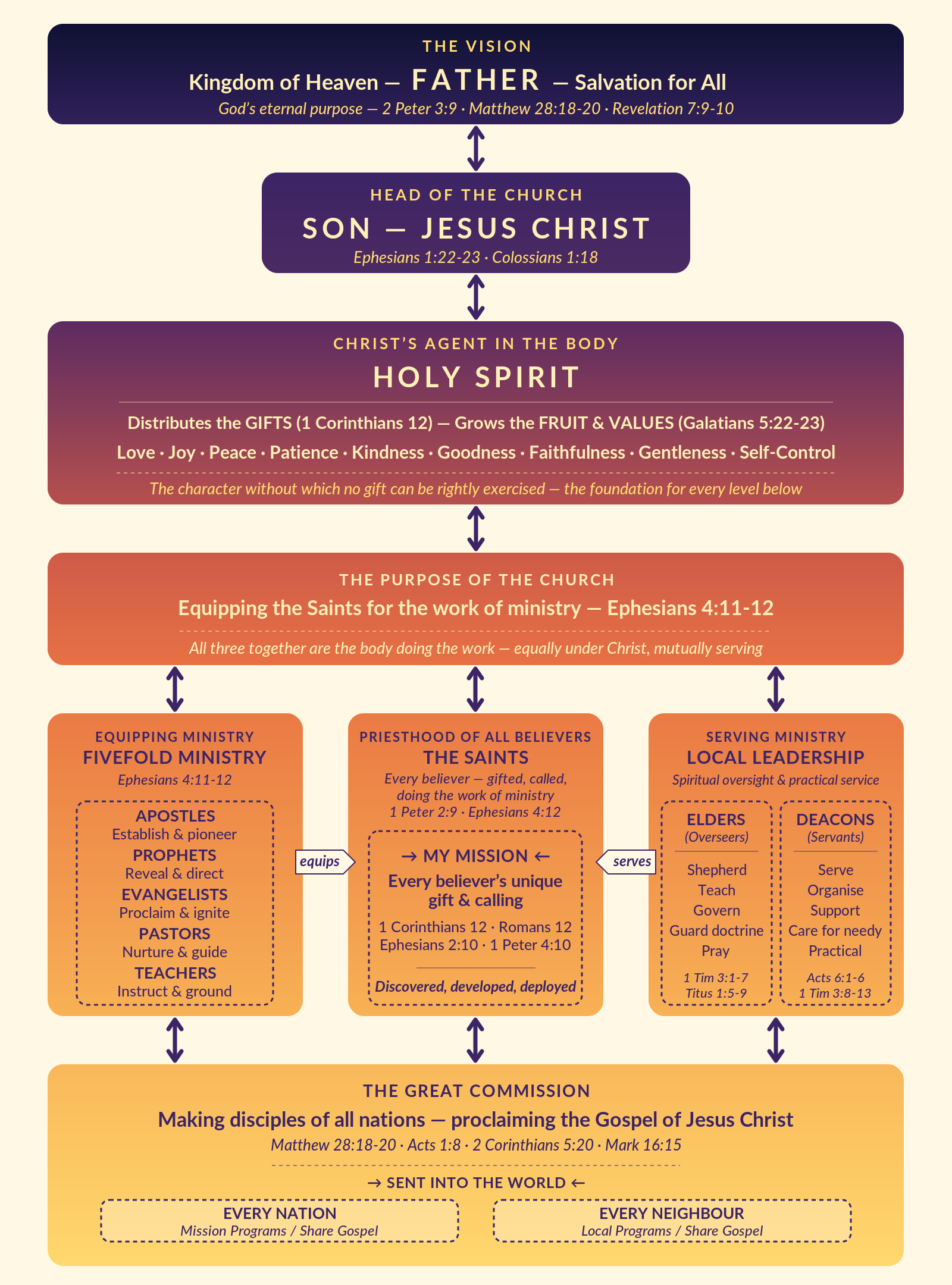
9.1 Reading the Diagram — The Five Framework Terms
The diagram is read from top to bottom, with the five framework terms made visible in sequence. Each term has been defined precisely in the earlier chapters of this document, and the diagram simply shows how they fit together as one integrated whole. The earlier version of this diagram showed five separate boxes for the five terms; the present version consolidates two pairs where the boxes were saying the same thing — Values into the Holy Spirit box (the Spirit is the One who grows the fruit), and the World into the Commission box (the Commission is precisely the sending into the world). The five terms remain; the boxes are now four, more visually generous, with no nuance lost.
1. THE VISION (top banner) — God’s eternal purpose
Everything begins with God’s vision: salvation for all to enter the Kingdom of Heaven. This is the eternal purpose toward which Christ was sent, the Spirit is at work, and the Church is established. “Where there is no vision, the people perish” (Proverbs 29:18) — vision is not optional; without it God’s people lose their way. This vision works at every level: the corporate vision of what God is looking to achieve through His global Church, the vision He has for each local church, and the personal vision He sets before every individual Saint. A corporate vision, a local vision, and a personal vision — each is the picture of what should be but is not yet, and it is precisely this picture that drives purpose and mission in every church and every Saint called to His Kingdom work. Every other element in the diagram exists to serve this vision. A church that loses sight of the vision will drift, regardless of how well-structured the rest of its life is. (See Chapter 1 for the full treatment of God’s Vision.)
2. THE PURPOSE OF THE CHURCH (the framed band) — equipping the saints
The Church’s Purpose is to equip the saints for the work of ministry, with Christ as Head. In the diagram, a horizontal brown banner names this Purpose and pulls in the defining scripture: “Equipping the Saints for the work of ministry — Ephesians 4:11-12.” Directly beneath that banner sits the thin brown frame that wraps the three columns — the Fivefold Ministry, the Saints, and the Local Leadership. These three together are what the Church’s Purpose looks like in action.
Christ and the Holy Spirit are deliberately shown above the Purpose banner, not inside it. Christ is the Head of the Church (Ephesians 1:22-23; Colossians 1:18) — not part of the Purpose but the One who gives it. The Holy Spirit is Christ’s agent in the body, distributing gifts and growing fruit — not part of the Purpose but the One who animates everyone who carries it out. The Purpose itself is the equipping work that the three columns together embody, under Christ’s headship and by the Spirit’s power. (See Chapter 2 for the full treatment of the Church’s Purpose, and Chapter 6 for the governance structure in detail.)
Flat Governance — The Three-Column Structure
Within the Purpose band, three columns stand at the same level. This is a deliberate visual decision and a careful biblical one. Many churches place the fivefold ministry above the elders and deacons, and both of them above the Saints. That stacked layout could be misread as a chain of command — with the fivefold at the top, the Saints at the bottom, and authority flowing downward. That is not the New Testament pattern.
Instead, the New Testament shows three groups working together at the same level, all serving the same end:
- The Saints (centre) — every believer, gifted and called, doing the work of ministry (Ephesians 4:12). The Saints are the body. They are not the audience for ministry; they are those who carry out the ministry.
- The Fivefold Ministry (left) — apostles, prophets, evangelists, pastors, teachers. Their function is to equip the saints (Ephesians 4:11-12). They are not over the Saints. They exist for the Saints. Without Saints to equip, the fivefold ministry has no purpose.
- Local Leadership (right) — elders and deacons. Elders provide spiritual oversight, shepherding the flock as humble examples rather than as those “lording it over” those in their care (1 Peter 5:1-4). Deacons provide practical service — the very word “deacon” means servant (Acts 6:1-6). Both serve the Saints. Neither rules over them.
The three columns are connected horizontally in the diagram by short labels — “equips” from the Fivefold to the Saints, “serves” from Local Leadership to the Saints. All three columns share the same colour to reinforce that they stand at the same level under Christ — none ranks above the other. The Saints are in the middle visually because they are central in function: the whole equipping framework exists for them, not over them. All three columns connect upward to Christ and the Holy Spirit (the source of authority and giftedness for every level), and downward to the Great Commission (the shared outward calling).
This is what is meant by “flat governance” in the biblical sense: not the absence of leadership, but leadership that serves rather than dominates. Christ is the only Head. All others — whether apostles or pastors, whether elders or deacons, whether the longest-serving member or the newest convert — stand under His headship and serve the same body.
3. MY MISSION (inside the Saints box) — every believer’s unique gift & calling
Within the Saints box, the Mission is shown as a sub-band labelled “MY MISSION.” The first-person framing is deliberate. This makes explicit what Chapter 4 sets out at length: every believer has a Mission — a unique set of gifts and a particular calling that no one else can fill. It is not a generic mission shared in common; it is one’s own, given personally by God, to be stewarded personally. Mission, in this framework, is not the geographic outward direction; it is the individual believer’s personal stewardship of the gifts the Spirit has distributed and the good works God has prepared in advance specifically for them (Ephesians 2:10). Every Saint has a Mission; no believer is without gift or calling. Each must be able to say, in time, what their Mission is — not someone else’s. The fivefold ministry and the local leadership exist to help each Saint discover, develop, and deploy their own Mission. (See Chapter 4 for the full treatment, and Documents 2, 3 and 4 for the practical work of discerning it.)
4. THE GREAT COMMISSION (the band below the Purpose) — making disciples of all nations
Below the Purpose framework, the Great Commission is shown as a single integrated box. The top of the box names the Great Commission itself and states its essence in a single line: “Making disciples of all nations — proclaiming the Gospel of Jesus Christ” (Matthew 28:18-20; Acts 1:8; 2 Corinthians 5:20; Mark 16:15). This is not a generic calling to be a good neighbour or to live morally; it is the specific calling to spread the Gospel of Jesus Christ — that Christ died for sinners, rose again, and saves all who repent and trust in Him — and to disciple those who respond. The full sixteen dimensions of the Great Commission are set out in Chapter 3. A dashed line then marks the transition into the world outside the Church. Two sub-boxes within the Commission name the two practical dimensions of the outward calling: “Every Nation — Mission Programs” on the left, and “Every Neighbour — Local Programs” on the right. The dashed line marks the world as distinct from the Church — the world is not part of the Church, but it is the field into which the Church is sent.
The two sub-boxes reflect the spectrum Christ Himself named when He commissioned His disciples: “You will be my witnesses in Jerusalem, and in all Judea and Samaria, and to the ends of the earth” (Acts 1:8). Local Programs — the church’s outward ministry to its immediate neighbourhood, community, suburb, and city — correspond to Jerusalem and Judea. Mission Programs — the church’s sending and supporting of cross-cultural witnesses, partnerships with churches in other nations, and direct participation in global gospel work — correspond to the ends of the earth. A church faithful to the full Commission gives sustained attention to both. To focus only on Local Programs is to forget that the gospel is for every nation. To focus only on Mission Programs is to overlook the neighbour in front of you. Both together fulfil what Christ commanded.
These two sections are held together in one box because they are inseparable in scripture. The Commission is the sending. The world is what we are sent to. To name the Commission without naming the world would be abstract. To name the world without the Commission would be unanchored. The single box says: this is what every Christian is called to do, and this is the field into which they are called. Where Mission is unique to each believer, the Commission is shared by all. A church that is gathered but not sent has missed the point of its own existence. (See Chapter 3 for the full treatment of the universal Commission.)
5. THE VALUES (within the Holy Spirit box) — the fruit of the Spirit
The Values — the fruit of the Spirit (Galatians 5:22-23) — are shown within the same box as the Holy Spirit Himself. This is theologically deliberate: the Spirit who distributes the gifts is the same Spirit who grows the fruit. The two are inseparable. The Holy Spirit box in the diagram therefore contains the Spirit’s twofold work: distributing the gifts (1 Corinthians 12) and growing the fruit/values (Galatians 5:22-23). The nine fruits are listed by name: love, joy, peace, patience, kindness, goodness, faithfulness, gentleness, and self-control.
The Values are the foundation for every level below. Elders without the fruit are not qualified to lead. Deacons without the fruit cannot serve faithfully. Members of the fivefold ministry without the fruit cannot equip with grace. Saints without the fruit cannot exercise their gifts in a way that builds up the body. The values are not a step in the process; they are the character without which no gift can be rightly exercised at any level. The Spirit who gives the gifts is the same Spirit who grows the character that makes their exercise faithful. (See Document 2 (The Theology of the Gifts) for the full treatment of the fruit of the Spirit and how it relates to the gifts.)
9.2 Why Flat Governance Matters
The three-column structure visible in the diagram is not a stylistic preference. It reflects a substantive biblical conviction with practical consequences for how a church is led, structured, and lived.
The temptation toward hierarchy is constant.
Every age of the Church has had to resist drift toward stacked hierarchical structures — where ministry credentials, ordination level, board position, financial contribution, or platform presence become substitutes for the New Testament pattern of mutual service under Christ. Such structures usually look organised and efficient. They are also frequently the breeding ground for the failings Christ warned against in Chapter 7: leaders unaccountable to the body, members silenced as unspiritual when they raise concerns, gifts of the Spirit concentrated in a few rather than distributed across all, and the Saints reduced to spectators rather than ministers.
Christ’s own teaching is explicit.
Jesus addressed this directly. “You know that the rulers of the Gentiles lord it over them, and their high officials exercise authority over them. Not so with you. Instead, whoever wants to become great among you must be your servant, and whoever wants to be first must be your slave” (Matthew 20:25-27). The pattern of authority in the church is inverted from the pattern of authority in the world. The greatest is the one who serves most. The leader washes the feet of those he leads.
The fivefold ministry is for equipping, not for being served.
Ephesians 4:11-12 is precise on this point: Christ gave apostles, prophets, evangelists, pastors, and teachers “to equip His people for works of service.” The fivefold gifts are not given so that the rest of the church can sit and be ministered to. They are given so that the Saints themselves are equipped to do the ministry. A church where the fivefold ministry does all the ministry, while the Saints look on, has misread Ephesians 4.
Elders shepherd; they do not dominate.
Peter’s charge to elders is among the clearest in the New Testament: “Be shepherds of God’s flock that is under your care, watching over them — not because you must, but because you are willing, as God wants you to be; not pursuing dishonest gain, but eager to serve; not lording it over those entrusted to you, but being examples to the flock” (1 Peter 5:2-3). Elders have real authority — the authority of teaching, of governing, of guarding doctrine. But that authority is exercised through serving and example, not through hierarchy.
Deacons serve; they do not run things.
The deacons of Acts 6 were appointed precisely so that the apostles could devote themselves to prayer and the word, while the practical needs of the body were carefully met. Deacons are not the corporate board. They are servants chosen for their character, qualified by their integrity, and tasked with the practical care of the church family and its outward service.
The Saints do the ministry.
The most important visual statement of the diagram is that the Saints box is the largest and is central. This reflects the New Testament reality: every believer is a priest (1 Peter 2:9), every believer is gifted (1 Corinthians 12), every believer has good works prepared in advance (Ephesians 2:10), and every believer is a steward of God’s grace in some particular form (1 Peter 4:10). The fivefold ministry exists to equip the saints to do the ministry. The local leadership exists to shepherd and serve the Saints as they do the ministry. The ministry itself is done by the body. A church in which only a few minister, while the many watch, has misread the New Testament.
9.3 How Mission and Commission Work Together
Because the framework distinguishes Mission (individual) from Commission (universal), it is worth making the relationship between them explicit. The two are not in tension; they are two dimensions of the same calling on every believer.
- Every believer is called to the Commission — to be a witness, to make disciples, to love one another, to do good works, to serve, to give. None of the sixteen dimensions of the Commission in Chapter 3 is optional or specialised; they apply to every Christian regardless of gift mix.
- Every believer has a Mission — a particular set of gifts and a particular calling through which they participate in the Commission. The teacher participates in the Great Commission by teaching; the mercy-shower participates by caring for the vulnerable; the giver participates by generous giving; the evangelist participates by direct gospel proclamation. The Commission is what everyone does; the Mission is how each one does it.
- A church that emphasises Commission without Mission produces guilt — everyone feels they should be doing everything, no one can do it all, and the weight crushes faithful believers. A church that emphasises Mission without Commission produces individualism — everyone discovers their “unique calling” but the universal duties of every Christian are quietly set aside. Both together produce a body in which every Saint is equipped to do their particular Mission while fully engaged in the shared Commission.
9.4 How to Use This Diagram
For new church plants:
Use this diagram as a design template. Before establishing the legal structure, settle the spiritual structure: How will Christ’s headship be honoured in decision-making? How will the Spirit’s gifting in members be identified, developed, and released? How will the equipping ministry of the fivefold actually equip — not perform on behalf of — the Saints? How will elders shepherd without lording it? How will deacons serve without becoming a corporate board? How will every Saint be helped to discover their Mission and live their Commission? What does going out to the world look like in this season? What are the cultivation practices that will keep the Values (fruit of the Spirit) at the foundation?
For existing churches considering realignment:
After completing the self-examination of Chapter 7, the leadership may conclude that the current structure has drifted from the biblical pattern in one or more ways. Common findings include: ministry concentrated in a few platform figures rather than equipping every Saint; elders chosen for professional credentials or financial influence rather than biblical qualifications; deacons functioning as a corporate board rather than as servants; Saints treated as audience rather than as the gifted body; Saints unable to name their Mission; the Commission preached but not lived; the Values eroded by celebrity, busyness, or compromise; a stacked hierarchy emerging where the New Testament shows a flat governance of mutual service. The diagram offers a picture of what realignment toward the biblical pattern looks like — not as a corporate restructure, but as a recovery of the New Testament vision of the Church.
For ongoing self-examination:
Even a faithful church benefits from holding this picture up regularly. Is the Vision still in view? Is the Purpose being lived — are Saints actually being equipped, or only entertained? Do Saints know their Mission, or are gifts sitting unused? Is the Commission alive in the church’s outward movement, or has the church become inward-facing? Are the Values (the fruit) visibly evident in leadership and in the body? Is the governance genuinely flat under Christ, or has hierarchy quietly reasserted itself?
9.5 What This Diagram Does Not Show
A single page necessarily simplifies. The diagram does not capture every dimension of the church’s life. A few things should be held explicitly in mind alongside it.
- The diagram is not a legal corporate structure. Churches operate within national, state, and denominational legal frameworks that often require boards, officers, treasurers, and named legal representatives. The biblical eldership and the legal board may overlap but they are not the same. The biblical pattern should inform — not be replaced by — the legal structure.
- The diagram is not exhaustive of ministries. Worship leadership, music, children’s ministry, youth, missions, hospitality, mercy ministries, evangelism teams, small groups, and many other expressions of the body’s life are not separately depicted. They emerge from the Saints, exercising their Mission gifts, equipped by the fivefold ministry, supported by deacons, overseen by elders, and engaged in the Commission.
- The diagram does not show the Trinity in full. Christ is shown as Head of the Church; the Father’s eternal vision is shown above; the Spirit is shown as Christ’s agent in the body. The triune nature of the one God is the deeper reality from which the whole picture flows, not a separate element.
- The diagram does not show time, growth, or seasons. Churches grow, plant other churches, send missionaries, suffer, recover, multiply. The diagram is a snapshot of structure, not a video of life.
- The diagram does not show relationships with other churches. The local church is not the whole Church. It exists in fellowship with other faithful churches locally, regionally, and globally. The wider church-to-church relationships of mission partnership, mutual accountability, and shared confession are real but beyond the scope of this single-page picture.
9.6 How Flat Governance Works in Practice — The Missing Link
The diagram shows the structure, but how does it actually work in practice? This section names the missing link — the layer of work that turns the high-level pattern into something that actually functions on the ground in a local church.
What we set aside in this section. Three things are deliberately outside scope here. First, the fivefold ministry: the roles are clearly defined in scripture and have been treated in Chapters 2 and 5. They are equippers of the Saints, not the operators of local church life.
Second, the legal structure: every church already operates within a legal framework — a corporation, a charity, an association — determined by its jurisdiction. The biblical pattern should inform that framework but does not replace it; where the legal form cannot easily be changed, the biblical pattern can still shape the practice within whatever shell exists.
Third, denominational structures: some churches sit within denominations whose internal arrangements are deeply embedded and not readily changed. (Some — the highly centralised structures of the Catholic Church, for example — embed inflexible bureaucratic processes that limit effective change.) The purpose of this document is not to address denominational reform. Its purpose is to steer willing new churches, existing churches considering realignment, forming churches, and indeed families onto the right path. Where a believer or family finds themselves in a place that does not allow the biblical pattern to function, the Holy Spirit will, in His time, draw them toward where the Kingdom can advance — and that work is between them and the Lord.
The missing link is the local leadership — the elders and deacons. These are the highly regarded, spiritually mature, gifted and called Saints whose work makes the difference between a flat governance structure that exists on paper and one that actually functions in practice. The fivefold equip; the Saints minister; the board (where one exists for legal reasons) governs at a high level; but the elders and deacons are the operational backbone of the local body. Without them in place and doing their work, the structure stays theoretical.
Who they are and how they are identified. The biblical qualifications are already set out in Chapter 6: tested character, faithful in family and finances, sound in doctrine, respected inside and outside the church, gifted and called to the work. In a healthy church the current leadership — typically the board and the lead pastor — are the first to recognise these Saints in their midst and call them forward. There is no single elder or deacon — the New Testament pattern is always a team, distributing the load and providing mutual accountability among the leaders themselves. Once recognised, their appointment is confirmed by the body and marked by prayer and the laying on of hands (as in Acts 13:3 and 1 Timothy 4:14, already treated in Chapter 6).
Where they sit. Critically, the elders and deacons do not sit on the corporate board. They sit within the Body of Christ — not as a committee above the people, but as servants alongside them. This is the heart of the New Testament pattern Chapter 6 explored: shepherds, not lords; examples to the flock, not those “lording it over” them (1 Peter 5:3). The legal board attends to financial accountability and transparency. The elders and deacons attend to the spiritual life and operational shape of the body.
What they actually do — the core function. Their core work is, in practice, fivefold:
1. Identify the gifts and callings of every Saint in the body, as a key part of each Saint’s discipleship. Each member is gifted; each gift must be discerned, named, and developed. Companion Documents 2, Document 3 (The Self-Assessment Guide), and Document 4 (the Spiritual Gifts Assessment) in this series exist to help with this work at the individual level; the elders and deacons hold and shepherd it at the body level.
2. Work, in prayer and with the leading of the Holy Spirit, to make sense of how all those gifts fit together — where each Saint’s Mission contributes to the body’s shared Commission. Here the eldership must resist a subtle but serious trap: you cannot call the Saints to wait on the Lord to hear His voice, and then hand them a plan and say, “this is what He said.” The eldership’s task is not to originate the direction but to confirm it corporately — to test, weigh, and recognise together what Christ is already saying to His body.
The New Testament model is exact: “It seemed good to the Holy Spirit and to us” (Acts 15:28) — not “the pastor and the committee have heard from God, and this is what we are doing.” The eldership shepherds sound doctrine and guards the process of listening; it does not manufacture the direction. The direction comes from Jesus Christ Himself, the Head of His Church. The faithful church is the one that stays faithful to that process — waiting on Jesus, in unity, as the disciples did at Pentecost — a body that says with one voice, in effect: “we will not move from here until we have heard Your voice and Your direction.”
3. Plan and organise the body’s callings into a coordinated effort — local programs in the immediate neighbourhood, national programs across the country, and international programs to the ends of the earth (the two boxes in the Great Commission band of the diagram).
4. Carry the operational layer: fundraising, budgeting, and the management of the day-to-day work at the delivery level. This is not the board’s high-level governance — it is the practical running of the body’s shared ministry, done by those gifted in administration (1 Corinthians 12:28) and servanthood (Acts 6:1-7).
5. Recognise when a Saint is ready to be released into their particular work, and confirm and send them through prayer and the laying on of hands — the Acts 13 pattern, completing the loop from gift to ministry.
The Moses pattern — distributed responsibility, manageable groups, shared burden. This is the work pictured at the start of Israel’s nationhood, when Moses was attempting to bear the whole weight of governance alone. On Jethro’s counsel, he divided the people into manageable groups, with capable leaders set over each group at multiple levels. The point is not the specific numbers — thousands, hundreds, fifties, tens — but the principle: manageable groups, manageable tasks, distributed responsibility, no one burning out. The same principle applies to the local church. Where the work is shared across many capable Saints, the body functions; where it is concentrated in one figure, the body grows tired and falters.
Exodus 18:21
“But select capable men from all the people — men who fear God, trustworthy men who hate dishonest gain — and appoint them as officials over thousands, hundreds, fifties and tens.”
The Acts pattern — one body, shared burden, generous giving. This is what we see in the earliest church. The believers worked as one. They had everything in common. They sold property and possessions to give to anyone in need. They gave generously for the advance of the gospel. This is what a healthy church looks like in practice: not a single figure carrying everyone else, but a body in which every member contributes and every burden is shared.
Acts 2:44-45
“All the believers were together and had everything in common. They sold property and possessions to give to anyone who had need.”
Acts 4:32
“All the believers were one in heart and mind. No one claimed that any of their possessions was their own, but they shared everything they had.”
What this frees the lead pastor to do. When the elders and deacons are doing the operational work of identifying gifts, coordinating callings, and running programs, the lead pastor’s role becomes what it was always meant to be — the spiritual care of the Saints rather than the running of the church machine. The pastor shepherds, teaches, prays, watches over souls; the elders share the governance and the discipline; the deacons handle the practical service; the board (where it exists for legal purposes) ensures financial accountability and transparency at the high level. No single role carries the whole weight; every role serves the whole body. This is the structural answer to the one-man-show critique of Chapter 8.
Closing the loop — confirmation and release. The work has a destination. As the elders and deacons do this work over time — in prayer, fasting, attentiveness to the Spirit’s leading — there comes a point at which a Saint’s gifts and calling become clear enough to be confirmed and released. This is precisely what we see in the early church at Antioch:
Acts 13:2-3
“While they were worshiping the Lord and fasting, the Holy Spirit said, ‘Set apart for me Barnabas and Saul for the work to which I have called them.’ So after they had fasted and prayed, they placed their hands on them and sent them off.”
The same pattern operates in every age. There comes a moment when Christ has led, the Saint has come to understand their gifts and their calling, the elders and deacons have done the work of discernment alongside them — and the body, in prayer and the laying on of hands, sends the Saint into the work. This is the New Testament release: every believer doing the work of the ministry that God has prepared in advance for them (Ephesians 2:10).
The result — the Church gets built. This is how the Church gets built. The Saints do their work; the Spirit does His. Hearts and minds are changed. The gospel goes out. The body multiplies. The Kingdom advances. The flat structure is not a description of a meeting — it is the engine of growth, when the missing link is in place.
Funding the Work
Where money is involved, the New Testament is strikingly free of the legalistic minimums that often shape modern Christian giving. The early church’s pattern, as we have seen, was generous, voluntary, and Spirit-led: believers giving as they were able and as the need required, holding their resources lightly and laying them at the apostles’ feet for the work and for the welfare of the body (Acts 2:44-45 and Acts 4:32, both quoted above).
The New Testament principle of giving. Paul names the underlying principle directly:
2 Corinthians 9:7
“Each of you should give what you have decided in your heart to give, not reluctantly or under compulsion, for God loves a cheerful giver.”
This is a different posture from the Old Testament tithe of ten percent. The believer is not bound to a fixed percentage minimum. The standard is what each one has decided in their own heart, given cheerfully, before the Lord. For some believers in some seasons that will be more than ten percent; for others in other seasons it may be less; for many it will move up and down with the season of life. The constant is not the percentage. It is the posture: voluntary, generous, faithful, before the Lord.
Why this works. When a Saint is genuinely invested in the work of the ministry alongside other Saints — operating in their gift, living out their calling with family and fellow believers called to the same work, sharing in the burdens and the joys — something happens that mere obligation can never produce: a sense of purpose, belonging, and shared mission. It is what we see in the early church. The believers gave because they were one body, one work, one Spirit. The giving was the natural expression of the unity.
This stands in contrast to a bare-minimum legalistic mindset: “I have given my ten percent, I have volunteered on this or that program, I have attended church each Sunday — I have done my part.” That mindset treats Christian life as a list of obligations to discharge. The Holy-Spirit-led posture is different: “I have a particular gift and a particular calling. I am living that out alongside other Saints who are doing the same. I am invested. Holy Spirit, what would you have me give to keep this work going — and to support the other works of ministry where I see faithful Saints labouring in genuine need?”
This kind of giving will be more than ten percent in some seasons and less in others. It will change with circumstances, with the body’s needs, and with the believer’s particular work. To a corporate church structure that needs predictable monthly income and an annual budget signed off in advance, this may seem uncertain — but it is precisely the faith-based posture God asks of His people:
Hebrews 11:6
“And without faith it is impossible to please God, because anyone who comes to Him must believe that He exists and that He rewards those who earnestly seek Him.”
Elders, deacons, and the visible need. When the elders and deacons are doing their work — knowing the Saints, coordinating the body’s shared ministry, walking with each member in their calling — they are also in a position to make the body’s actual needs visible. They can name plainly: this is what the fivefold ministry costs to sustain; this is what the local programs require; this is what the international work needs to continue. The Saints, hearing this from elders they trust and who know the work, can then decide before the Lord what part each will play. This is not fundraising in the corporate sense. It is the body, in fellowship, supplying its own needs.
The pay of those in ministry. Scripture is clear that those who labour in the ministry of the Word and oversight should be supported by the body they serve:
1 Timothy 5:17-18
“The elders who direct the affairs of the church well are worthy of double honor, especially those whose work is preaching and teaching. For scripture says, ‘Do not muzzle an ox while it is treading out the grain,’ and ‘The worker deserves his wages.’”
1 Corinthians 9:14
“In the same way, the Lord has commanded that those who preach the gospel should receive their living from the gospel.”
At the same time, scripture also shows that not every minister was supported full-time by the body. The apostle Paul, by his own choice, often supported himself through his trade as a tentmaker, working alongside Aquila and Priscilla (Acts 18:3) so that he would not be a burden to the churches he served (1 Thessalonians 2:9). His example does not weaken the principle of paying those who labour in the gospel — it adds a complementary one: in some seasons and for some servants of Christ, supplementing ministry with paid employment is a faithful and biblical option, particularly in church plants, small congregations, or seasons of constrained resources. The rule is not “always paid” or “always bivocational”; the principle is faithful provision for the work, met by faithful giving from the body, with practical flexibility shaped by what the work actually requires.
As the body engages — gifted, called, invested, Spirit-led in its giving — the work is funded, the workers are sustained, the gospel goes out, and the Body of Christ is built. The elders and deacons make the work visible; the Saints respond in faith; the Spirit moves through both; the Kingdom advances.
9.7 How This Connects to the Rest of the Framework
The framework diagram earlier in this chapter — the Strategy on a Page — is the picture. This whole document, Document 1 (Vision, Purpose, Commission & Mission), is its explanation: each of its nine chapters fills out one part of that diagram.
- Chapter 1 — the Vision, in three stages: God’s original Vision in Eden, what was lost in the Fall, and the future Vision He is bringing to consummation — His heart for all people to be saved and to enter His Kingdom.
- Chapter 2 — the Purpose of the Church: Christ as Head, the fivefold ministry equipping the saints, elders and deacons providing local leadership in mutual service.
- Chapter 3 — the universal Commission: the sixteen dimensions of what every Christian is called to do.
- Chapter 4 — the individual Mission: every believer gifted and called for a unique place in the body.
- Chapter 5 — the Gospel message the Church is sent to proclaim.
- Chapter 6 — the governance structure, in detail.
- Chapter 7 — the warnings to be heeded, so the structure does not drift into the failings Christ rebuked in His letters to the seven churches.
- Chapter 8 — a deeper dive into the warning: the decline of the Western Church, the Haggai and Laodicea pattern behind it, and the honest pause — take stock, repent, realign — before the pattern can be lived.
- Chapter 9 — this chapter: the whole picture drawn together on a single page.
Those chapters are all part of this document. The companion documents in this series go deeper still:
- Document 2 (The Theology of the Gifts) — the theology of the gifts and the fruit of the Spirit.
- Document 3 (The Self-Assessment Guide) — the self-assessment guide that helps each believer discern their Mission.
- Document 4 (the Spiritual Gifts Assessment) — the practical workbook, with questionnaire and reflection materials a person, small group, or eldership can use.
The whole series exists to help the Church live as the picture in this diagram describes — under Christ’s headship, animated by the Spirit who distributes the gifts and grows the fruit, structured by the Purpose of equipping, with every Saint discovering their Mission and living the Commission, sent into the world that Christ came to save, ordered in the flat governance of mutual service that the New Testament describes.
Beyond these, the Series grows, with more operational detail:
- Document 5 (The Annual Plan) — carries the framework into annual planning.
- Document 6 (Elder & Deacon Identification), Document 7 (The Christian Household) and Document 8 (Five-Fold Ministry) — eldership, the household, and the five-fold ministry.
- Documents 9 and 10 — the overview and the call.
- Document 11 (Example Constitution), Document 12 (Our Church), Document 13 (Church Decision Allocation), Document 14 (Redefining the Pastor’s Role) and Document 15 (Flat Governance — the evidence) — the constitution, plain-language operating reference, decision allocation, the redefined pastor role, and the flat-governance evidence.
- Document 16 (Approved and Disapproved Workers) and Document 17 (Conflict Resolution) — guarding the body: recognising approved and disapproved workers, and the conflict-resolution process for correcting and restoring them gently.
Document 9 (How It All Works Together) maps the whole Series and suggests reading orders.
9.8 The Foundation Is Laid
Everything in this diagram rests on one foundation, and it is not ours to lay. Scripture has already laid it — and it is a Person.
1 Corinthians 3:11
“For no one can lay any foundation other than the one already laid, which is Jesus Christ.”
Scripture names Him again as the chief cornerstone, the One on whom the whole building rises:
Ephesians 2:20-22
“…built on the foundation of the apostles and prophets, with Christ Jesus Himself as the chief cornerstone. In Him the whole building is joined together and rises to become a holy temple in the Lord. And in Him you too are being built together to become a dwelling in which God lives by His Spirit.”
The foundation is settled; nothing in these pages adds to it or replaces it. But once Scripture has laid the foundation, it turns and speaks directly to us — to the builders — and its charge is sobering.
1 Corinthians 3:10
“By the grace God has given me, I laid a foundation as a wise builder, and someone else is building on it. But each one should build with care.”
Build with care. The foundation cannot be shaken, but what we raise upon it can be built well or badly, and it will be tested (1 Corinthians 3:12-15). The care is not optional — it is the difference between a work that endures the fire and one that is burned up.
And the material we build with is not brick and mortar but people — the Saints themselves, each one a living stone.
1 Peter 2:4-5
“As you come to Him, the living Stone… you also, like living stones, are being built into a spiritual house to be a holy priesthood…”
This is why the whole of this document has laboured over gifts, callings, mutual service, unity, and the honest pause: the Church is not built out of programmes or structures but out of living stones, each one shaped, placed, and joined by Christ. To build with care is to handle one another as He does.
So build wisely.
Matthew 7:24
“Therefore everyone who hears these words of mine and puts them into practice is like a wise man who built his house on the rock.”
The wise builder is not the one with the best plan, but the one who hears Christ and obeys. The foundation is laid — Jesus Christ Himself, the chief cornerstone. Build on Him, build with care, build with living stones, and build wisely — and the house will stand, because the One it is founded on cannot be shaken.
Christ is building His Church (Matthew 16:18). The structure described here is not a human invention to be imposed; it is the pattern Christ Himself has set, the Spirit Himself has shaped, and the scripture itself has revealed. The Church that aligns with this pattern is not following a model — it is following Christ, the Head of the universal Church.