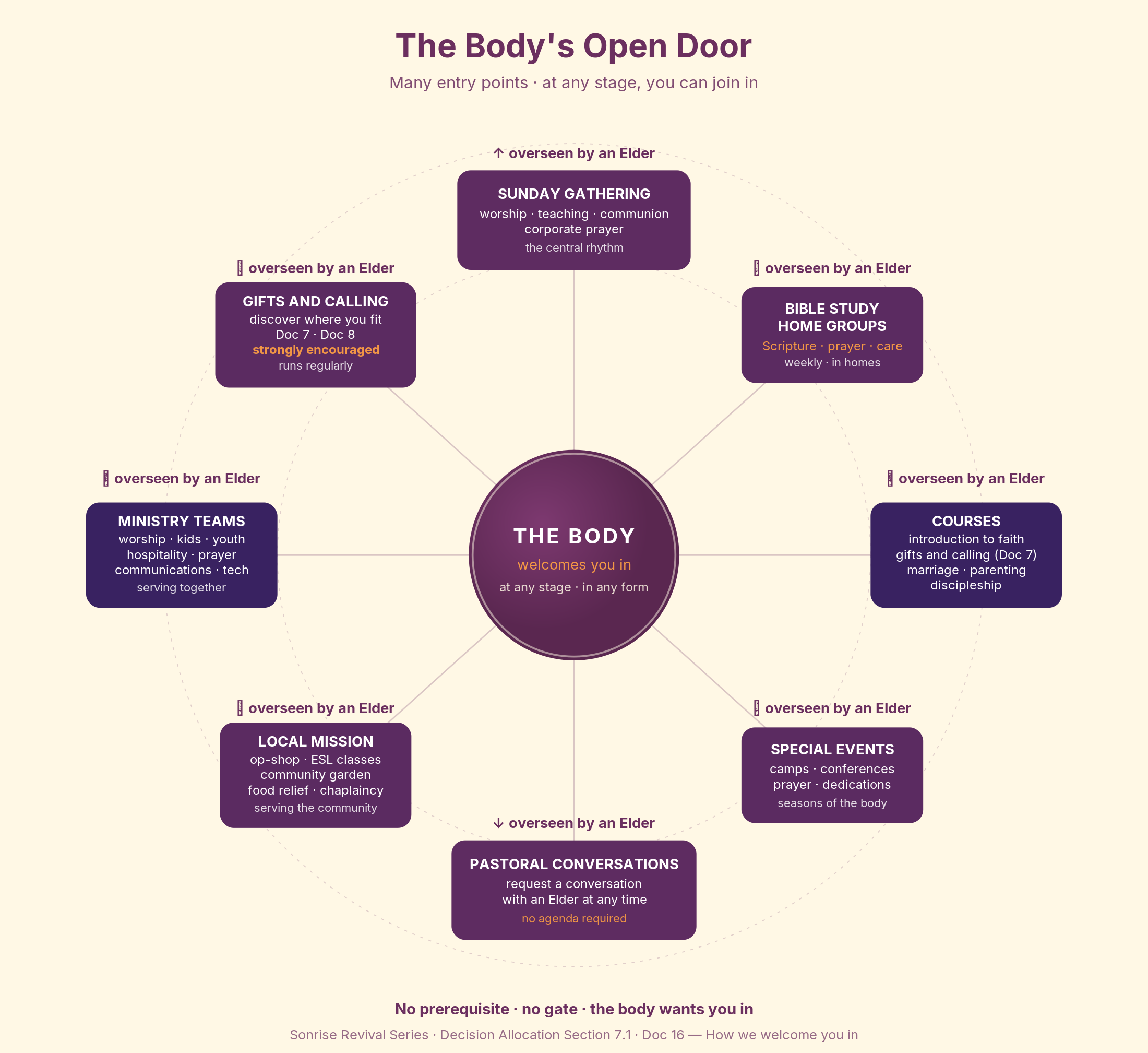
You are welcome at every stage. A short word about what we want you to hear plainly. You do not need to be a Member of this body to be fully welcome among us. You do not need to be a Member to join a Bible study, attend a course, serve on a ministry team, join in a local mission activity, discover your gifts, receive pastoral care, or contribute your voice to our annual planning workshops. The body’s life is open to every Saint at every stage of their walk with the Lord. There is no gate. We want you in.
Many entry points, one body. Each week our standing invitation goes out — from the Sunday gathering, from our website, from our regular communications, and from one Saint to another. The invitation opens onto many doors. You might join in through the Sunday service. You might come to a Bible study or home group running near you. You might attend one of our courses — an introduction to the Christian faith, a gifts and calling course, marriage or parenting, discipleship classes. You might serve in a local mission activity — the op shop, the ESL class, the community garden, the food relief, whatever we have discerned the Lord is calling us to in this community. You might join a ministry team — worship, kids, youth, hospitality, prayer, technical, set-up and pack-down. You might attend a camp, a conference, a prayer gathering. Each entry point is overseen by an Elder who will welcome you, walk with you, and over time help you see other options for involvement as your journey unfolds. Not as a gatekeeper. As a guide.
What Membership adds. Membership is the formal step that adds one specific thing: the right to vote at our General Meetings on the matters reserved by law to the Members. Those matters are the legal-entity decisions — Committee election, changes to our Constitution, the receiving of the audited financial statements, major property transactions, denominational affiliation changes, and (if the Lord ever brings the season to a close) the winding-up of the church. These decisions belong to those who carry the formal vote. Members also receive certain specific communications tied to that voting — supporting materials for the AGM, notices of Constitutional amendments under consideration, sub-annual updates on funding status against our agreed ministry works. And Members are eligible for nomination to the Committee.
What Membership does not change. The annual plan — the year’s ministry works, its budget, and the funding ask that goes with it — is not on that list. It is affirmed at the Annual General Meeting by every Saint contributing to this body through giving, through service, or both, whether or not they are formal Members. The work belongs to the body that carries it, so the voice on it belongs to the body that carries it. Membership adds a vote on the legal entity; it does not add a voice in the ministry the entity exists to serve, because you already have that.
Neither is the calling of a Pastor. A Pastor is an Elder who labours in preaching and teaching, and is called the way Elders are called — discerned by the Eldership and affirmed by the body, not selected by ballot. The release of a Pastor is an employment matter carried by the Committee, never a congregational vote on a person. Some churches do choose to put the calling of a Pastor to a Members’ vote; where this body has made that choice, it is recorded in our Constitution and named here.
Why we encourage Membership. We strongly encourage Membership for Saints who have walked with us for a season and are ready to commit. The body benefits when those who are walking with it carry voice on the decisions that shape its life. Without Members exercising that voice, the body’s legal decisions can become decisions made by a smaller group rather than by the broader body the work belongs to. Membership is the way the broader voice is carried on those decisions.
When you might take the step. You might consider Membership when you are ready, before the Lord, to do three things: affirm the Statement of Faith of this body as your own; walk under the Eldership’s spiritual oversight in matters of doctrine, discipline, and direction (and, in the rare case the body’s discipline becomes necessary, to walk through it with us rather than away from us); and carry a voice on our legal-entity decisions with the seriousness those decisions warrant — which means receiving the relevant communications, participating in the discernment, and committing to give regularly in support of what we have agreed to undertake. These are not gates. They are the postures that naturally accompany a Saint who is ready to commit formally. If you can say yes to these in clear conscience, you are ready to apply. If not yet, you are welcome to continue walking alongside until the moment is right.
How the step is taken. You apply in writing to the Eldership. You have a conversation with at least two Elders, where we hear your faith journey, talk through what Membership means, and answer any questions you have. The Eldership confirms your application at one of their regular meetings. You are publicly welcomed at a worship service, where the body prays for you and stands with you. From that moment you are a Member of the body, with full voice and full vote.
If you walk with us without taking the step. Some Saints walk with us for years without becoming Members. You may be visiting from another body, considering Membership but not yet ready, or coming from a tradition that does not practise Membership in this form. All of that is honoured. You are not a second-class participant. You are welcome in every entry point, ministered to in every season, prayed for in every crisis, restored in love if you fall. The only difference is the formal vote on the legal-entity decisions — that belongs to Members. Everything else of the body’s life is yours to walk in.
A word from us. We will not pressure you into Membership. We will not delay you once you are ready. We will keep extending the invitation — at the Sunday gathering, through our communications, in conversation with our Elders — so that no Saint walking with us is unsure whether they are welcome. They are. At every stage. In every way that matters. When the Lord calls you into the formal step of Membership, we will walk with you through it. When He moves you on, we will release you in His peace. The body is for the Lord, and the Lord is for the body, and you are welcome among us for as long as He keeps us together.