Parts One to Nine describe identification in a single congregation. Part Ten asks how many Elders and Deacons a growing body needs, and answers with the ratios that decide it.
10.1 — Why this Part exists
Everything to this point assumes an Eldership where every Elder can sit around one table, know one another, pray together, and reach unity in council. That holds to about 200 to 300 active adult Saints. Beyond it the body has grown larger than a single Eldership of eight to twelve can shepherd, and a question arrives that the identification process alone cannot answer: how many Elders does this body actually need?
The Framework’s answer is that the Eldership grows in number but stays equal in office. More Elders. More pastors among them. No Senior Pastor designation, no Executive Eldership tier, council together, the Lord at the Head. That principle — why the two common alternatives fail, what the New Testament shows, and how an Eldership of forty reaches genuine discernment without becoming a parliament — is set out in full in Church Decision Allocation, Section 6, because it is finally a question about who decides what as a body grows.
What belongs here is the counting. This Part gives the ratios that tell an Eldership how many Elders and Deacons to be identifying, and what that looks like at four sample body sizes.
10.2 — What the Eldership must not become
Two patterns are common in the Australian church and both are refused here, so that the numbers below are read for what they are.
The first is the corporate template: a Senior Pastor with concentrated authority who chairs the Eldership ex officio, holds a casting vote, and becomes the primary face of the body. The second is subtler — an Executive Eldership tier, a small group of senior Elders who make the substantive decisions while the rest become a rubber stamp. The first produces the one-man-show pattern Vision, Purpose, Commission & Mission Chapter 8 warns against; the second produces the same drift more slowly, under spiritual language. The case against both is made properly in Church Decision Allocation, Section 6.
The practical consequence for identification is this: growth is met by identifying more Elders, never by concentrating authority in fewer. Which means the ratios matter.
10.3 — The shape this produces
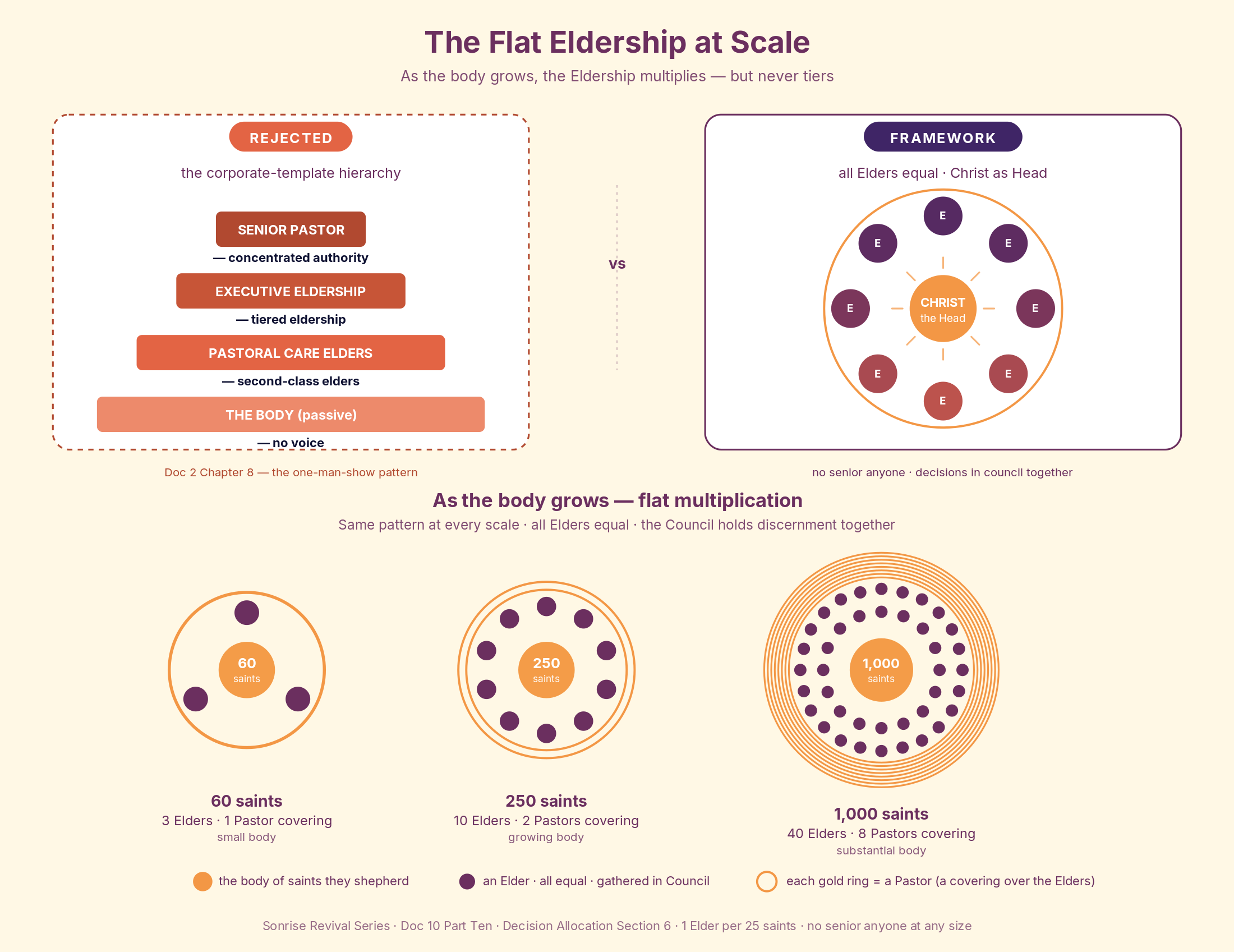
Figure — The Flat Eldership at Scale. As the body grows, the Eldership multiplies, but never tiers. One Pastor among five Elders is shown as a gold ring covering the Council.
Every Elder is equal. Different gifts — pastor, teacher, prophet, evangelist, apostle — mean different functions, not different ranks. A pastor is an Elder who carries the pastoral gift in the Ephesians 4:11 sense and holds no more authority than any other Elder. When the body needs more pastoral capacity, the Eldership identifies and installs more Elders carrying the pastor gift, through the same Part Four process used for every Elder. The body ends with many pastors, all of them Elders, all of them equal.
10.4 — The four ratios that matter at scale
Four ratios shape the practical scaling of an Eldership. The numbers are working targets, not absolute requirements. Healthy churches operate within the ranges given.
| Ratio | Target | Healthy range | Why this number |
|---|---|---|---|
| Saints to Elder | 1 : 25 | 1 : 20 — 1 : 30 | An Elder shepherding 25 Saints can know them personally, know their household, pray for them by name, notice when they are absent, see signs of struggle, walk with them through significant life events. At 1:35 and above, “knowing” starts to fragment into “managing”. |
| Saints to Pastor (Eph 4:11) | 1 : 125 | 1 : 100 — 1 : 150 | A pastor carries the teaching-with-pastoral-heart function and the pastoral leadership voice. At 125 Saints per pastor, the body has enough teaching depth and pastoral leadership without any single pastor being indispensable. |
| Elders to Pastor | 1 in 5 Elders | 1 : 4 — 1 : 6 | Not every Elder carries the Eph 4:11 pastor gift. Many are teachers, prophets, evangelists, or carry administrative gifting. Roughly 1 in 5 Elders typically carries the pastor gift specifically. |
| Saints to Deacons | 1 : 10 | 1 : 8 — 1 : 15 | The Diaconate is the practical-service office under 1 Timothy 3:8–13. Deacons handle the practical needs that flow out of pastoral care. The Exodus 18:21 ratio of officials set over tens is the biblical reference. |
And one ratio that does not scale with body size — the Operational Committee. A Committee of 5 to 9 members manages the legal stewardship regardless of how large the body becomes. Operational complexity grows; governance complexity does not. A Committee of 7 can handle operations for 100 Saints or 10,000 — the difference is met by professional support, not by adding committee members.
10.5 — What scaling looks like at sample body sizes
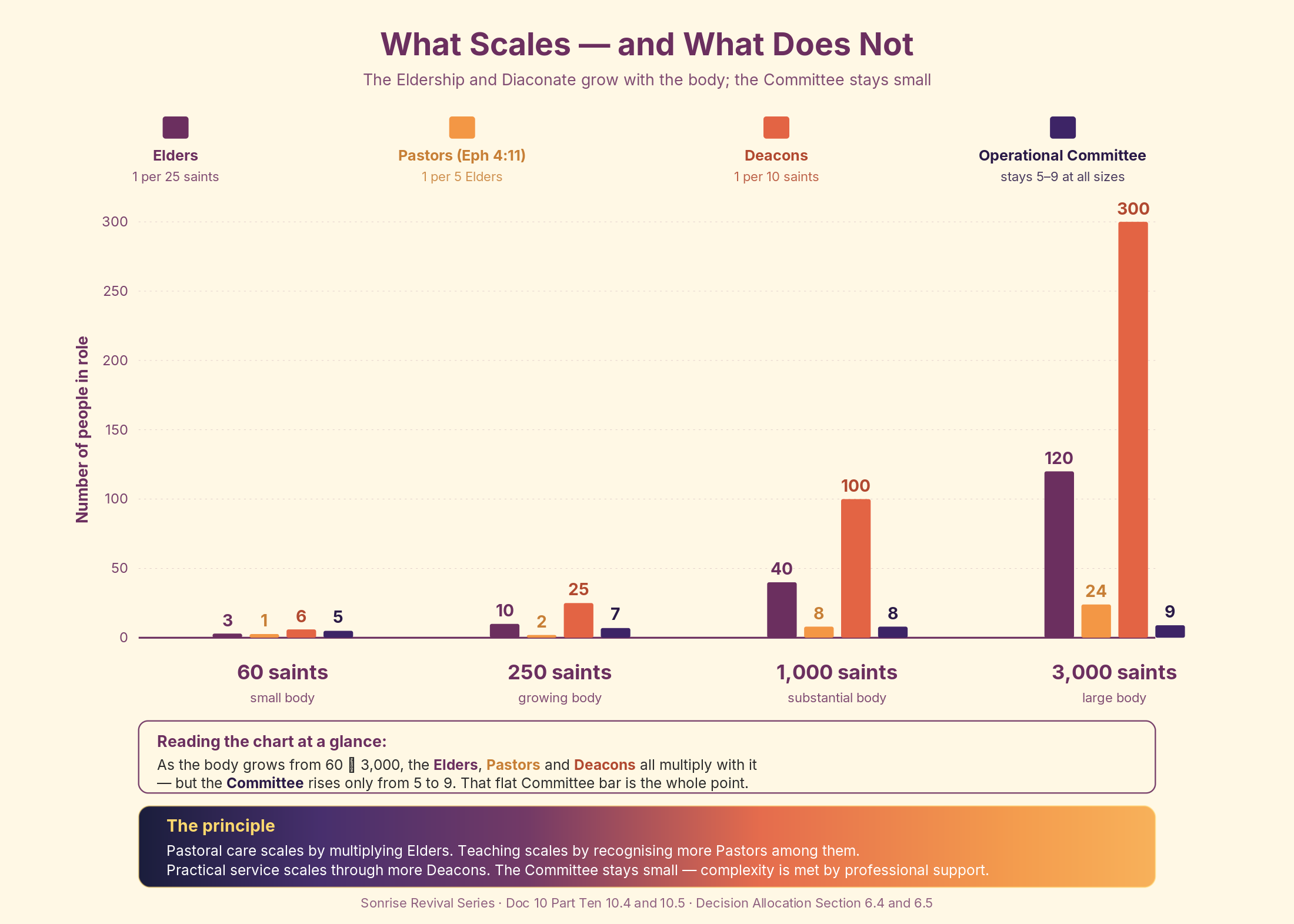
Figure — What Scales — and What Does Not. The Eldership and Diaconate grow with the body; the Committee stays small.
The four ratios applied at sample body sizes show the practical shape of a framework-aligned church at scale. The table is illustrative — actual numbers vary with the gift mix the Lord has raised in a particular body and the pastoral patterns the Eldership has discerned.
| Body size | Elders | Pastors (Eph 4:11) among Elders | Deacons | Operational Committee |
|---|---|---|---|---|
| 60 Saints | 3 | 1 | 6 | 5 members (drawn from Eldership) |
| 250 Saints | 10 | 2 | 25 | 7 members (drawn from Eldership) |
| 1,000 Saints | 40 | 8 | 100 | 7-9 members (drawn from Eldership) + small paid operations team |
| 3,000 Saints | 120 | 24 | 300 | 9 members (drawn from Eldership) + professional operations team |
Notice what scales and what does not. The Eldership and Diaconate scale roughly linearly with body size. The number of pastors scales linearly but at one-fifth the Elder rate, because not every Elder carries the pastor gift. The Operational Committee stays small regardless. This pattern protects the body from corporate-template drift while keeping legitimate operational capacity in place.
These counts will look high against what most churches carry. That is the point: a body of a thousand served by a dozen Elders is not running a lean eldership, it is running each Elder at three times the load under which anyone can shepherd well.
10.6 — Where the rest of this is treated
An Eldership of forty raises an obvious objection — that a council that large cannot discern together. It can, and the disciplines that make it possible (prepared agendas, listening rounds before conclusion, unity rather than majority as the standard, a chair who facilitates rather than leads, prayer framing the work) are set out in Church Decision Allocation, Section 6, alongside the scope of what the Eldership decides at all.
The same model appears in two other places, each for its own purpose. The Example Constitution carries it in legal language, so that the flat-eldership-with-pastors structure survives contact with the Associations Incorporation Act. Our Church carries it in plain language, so the body itself understands why there is no Senior Pastor designation and no Executive tier. Five-Fold Ministry, Part Ten takes up the one question this Part leaves open: what becomes of the non-pastoral Five-Fold gifts, which do not multiply one-per-25.
The flat multiplication model is what allows a framework-aligned church to grow into thousands without becoming a corporation. Concentrated authority feels necessary at scale only because the alternative, disciplined discernment in a flat Council, has not been practised. The discipline can be learned. The pattern can be operated. The body of Christ can grow large without abandoning the shape Christ Himself laid down for her.